One-sentence summary: Q is “what I am looking for,” K is “what label I advertise,” and V is “what content I contribute.” Query-Key dot products produce learned compatibility scores; normalized weights then blend the allowed Value vectors.
10.1 What This Chapter Covers
The previous chapter built the geometric intuition: a dot product can serve as a learned, magnitude-aware Query-Key compatibility score.
But several questions are still open:
- What do Q, K, and V actually mean?
- How are they generated from the input?
- How does the shape change at each step of the computation?
This chapter traces the complete Attention computation, step by step, keeping track of every dimension change.
10.2 The Input Shape
10.2.1 Understanding the Input Dimensions
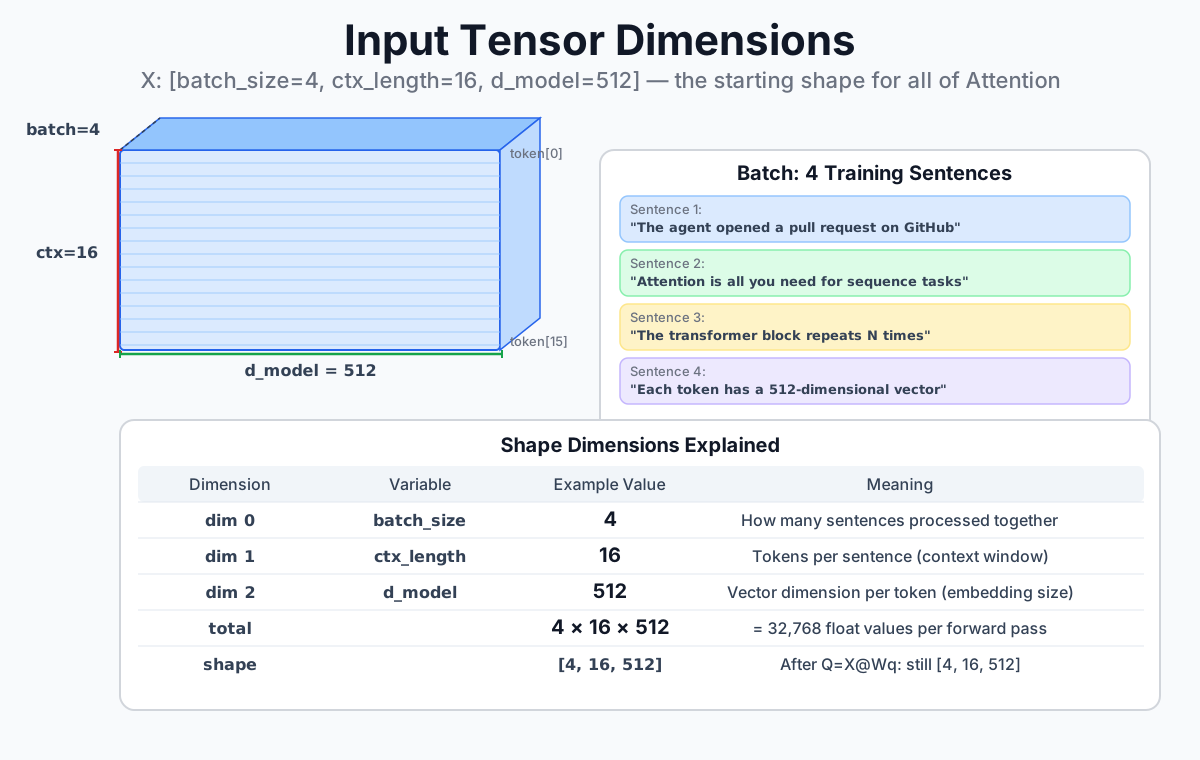
In practice, training processes multiple sequences at once. The input tensor has shape:
X: [batch_size, ctx_length, d_model]Using concrete numbers from the diagram:
batch_size = 4: four sequences processed in parallelctx_length = 16: each sequence has 16 tokensd_model = 512: each token is represented as a 512-dimensional vector
10.2.2 A Concrete Example
Imagine four prompts going through training at the same time:
1. "The luthier carried the theorbo into the..."
2. "The viol player tuned a gut string before..."
3. "A sackbut rested beside the cornett while..."
4. "The continuo part ended on a suspended..."
For this teaching example, each prompt is padded or truncated to 16 token positions, and each position is represented by a 512-dimensional vector.
Total input shape: [4, 16, 512]
- 4 sequences
- 16 positions each
- 512 dimensions per position
10.2.3 The Three Dimensions
| Dimension | Name | Meaning |
|---|---|---|
batch_size | batch | how many sequences we process at once |
ctx_length | context length | how many tokens per sequence |
d_model | model dimension | width of each token vector |
10.3 Generating Q, K, and V
10.3.1 The Core Idea
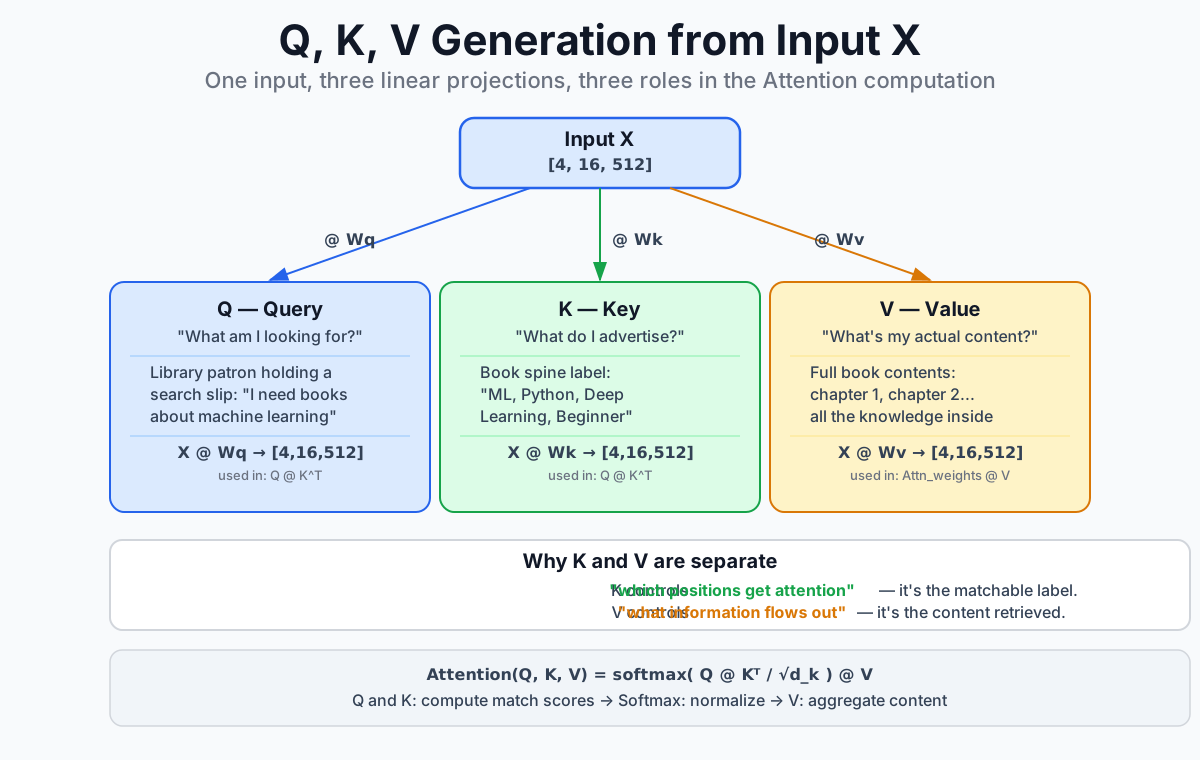
Q, K, and V all come from the same input X, through three different weight matrices:
Q = X @ W_Q
K = X @ W_K
V = X @ W_V
These weight matrices — W_Q, W_K, and W_V — are learnable parameters updated during training.
10.3.2 Dimension Calculation
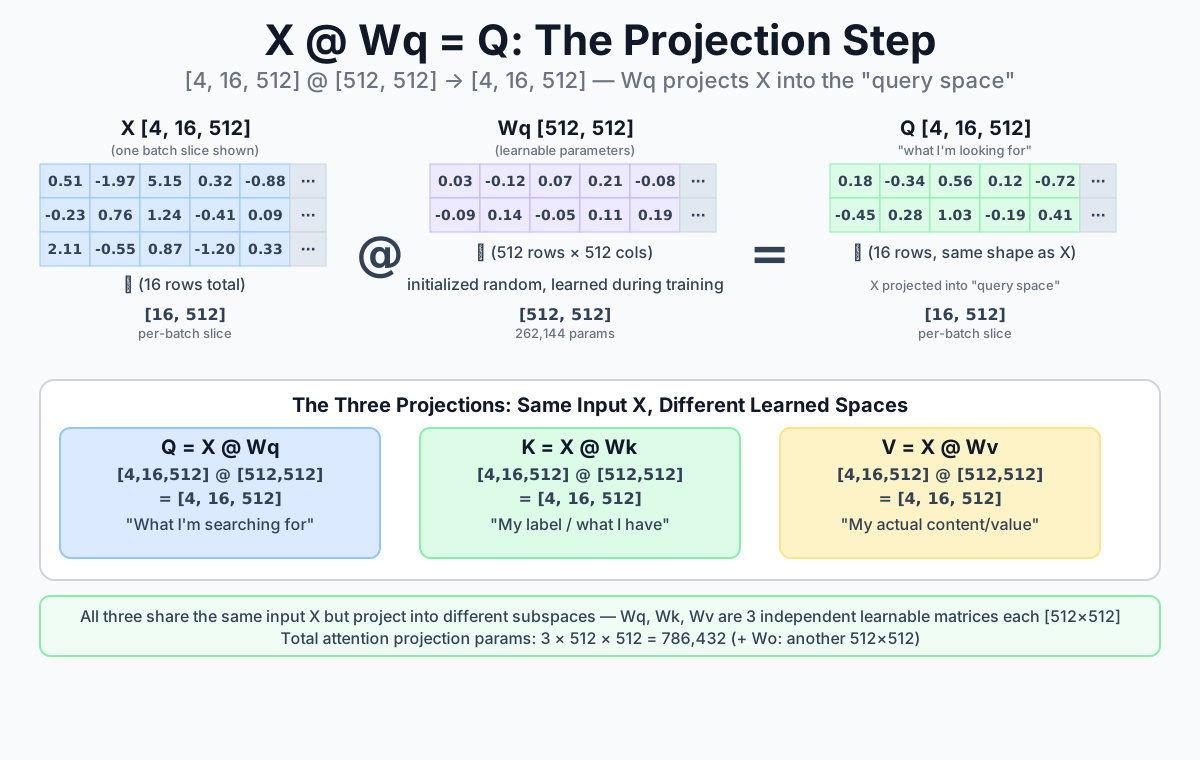
Take generating Q as an example:
X:  [4, 16, 512]   (batch_size, ctx_length, d_model)
W_Q:[512, 512]     (d_model, h × d_k)
Q:  [4, 16, 512]   (batch_size, ctx_length, h × d_k)
The matrix multiplication rule is [..., A, B] @ [B, C] = [..., A, C], so:
[4, 16, 512] @ [512, 512] = [4, 16, 512]In this conventional example, h × d_k = h × d_v = d_model = 512, so the combined Q, K, and V tensors happen to have the same shape as X. That is a design choice, not a rule: Q and K must share d_k within a head, while V may use a different d_v.
10.3.3 Why Three Different Matrices?
You might ask: if the output shape is the same, why bother with three separate matrices?
Because Q, K, and V play different roles:
- Q (Query): "What information am I looking for?"
- K (Key): "What information can I be found by?"
- V (Value): "What content do I offer when selected?"
By learning separate W_Q, W_K, and W_V, the model learns different views of the same input. Q and K land in compatible per-head spaces so their dot product is defined; V carries the features that will be mixed into the output.
10.3.4 An Analogy Worth Keeping
Think of a library search:
| Role | Analogy | Function |
|---|---|---|
| Query (Q) | The reader's search terms | “I want a book about early electronic instruments” |
| Key (K) | Each book's catalogue tags | “theremin, performance, history” |
| Value (V) | The book's actual content | The material the reader ultimately retrieves |
When you search:
- your Query is compared with each book's Key
- books with higher match scores receive larger normalized weights
- their Value content is blended according to those weights
Attention works the same way.
10.4 First Matrix Multiplication: Q @ K^T
10.4.1 Computing the Compatibility-Score Matrix
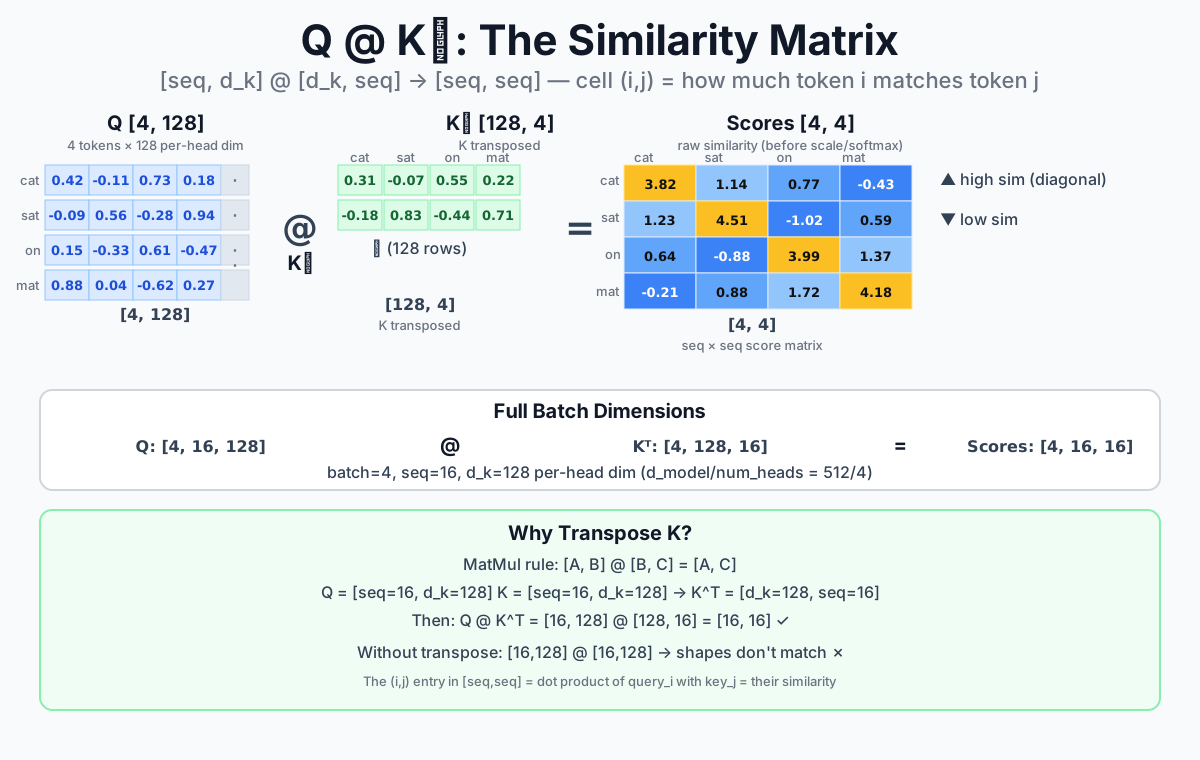
After the combined projections are reshaped into heads, the next step is computing Query-Key compatibility scores within each head:
scores = Q @ K^TK needs to be transposed (K^T) so that Q's rows (one per token) dot-product against K's rows (also one per token).
10.4.2 Dimension Change
Q:      [4, 4, 16, 128]   (batch, heads, seq, d_k)
K^T:    [4, 4, 128, 16]   (batch, heads, d_k, seq)
scores: [4, 4, 16, 16]    (batch, heads, query_seq, key_seq)
This example uses
h = 4andd_k = d_model / h = 512 / 4 = 128. Chapter 11 explains the head split itself; here we expose the head axis so the shape path stays honest.
10.4.3 What the Result Means
The result is a [4, 4, 16, 16] tensor:
- 4 sequences
- 4 heads per sequence
- each head has a 16×16 raw score matrix
- entry
(i,j)is the dot product of Query positioniand Key positionj
Here is a hand-built 4×4 example for the short prompt “luthier repairs theorbo .” The values below are illustrative raw dot products before scaling or masking; they were not measured from a trained model:
             luthier  repairs  theorbo   .
luthier  [   8.2,     3.1,     6.5,    1.2  ]
repairs  [   3.4,    11.7,     7.8,    2.0  ]
theorbo  [   6.8,     7.2,    12.3,    1.9  ]
.        [   1.3,     2.1,     1.7,    9.4  ]
The table was chosen only to make the arithmetic visible. Real heads need not have large diagonals, and a high raw score is not ground-truth semantic relevance. After scaling, masking, and row-wise Softmax, the scores become normalized mixing weights over allowed Key positions.
10.5 Scale: Why Divide by
10.5.1 The Scaling Step
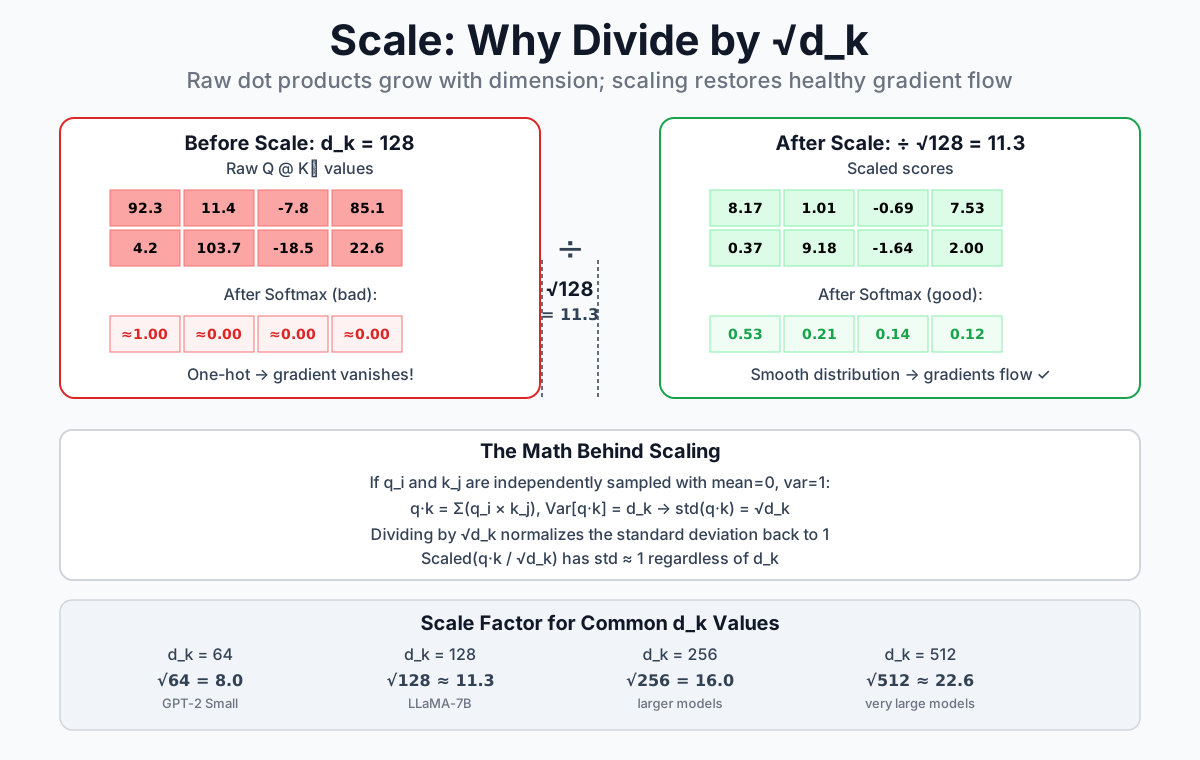
The raw scores from Q @ K^T are scaled by the head width:
scaled_scores = (Q @ K^T) / sqrt(d_k)The goal is not to force scores into a fixed interval. It is to keep their typical scale comparable as d_k changes.
10.5.2 Why Scale?
The problem: as d_k grows, the typical magnitude of an unscaled dot product grows too.
dot product = sum(q_i × k_i) # summing 128 multiplied pairsIf the components of Q and K are independent with mean 0 and variance 1, the dot product has variance d_k and standard deviation √d_k.
The consequence: large values drive Softmax to extremes.
Softmax([100, 1, 2])     ≈ [1.000, 0.000, 0.000]   # saturated
Softmax([1.0, 0.1, 0.2]) ≈ [0.539, 0.219, 0.242]   # less saturated
When Softmax saturates, most derivatives become very small and optimization becomes harder.
The fix: divide by so the idealized score standard deviation stays around 1 as head width changes.
dot product / sqrt(128) ≈ dot product / 11.310.5.3 Where It Sits in the Formula
The is the Scale step; M represents any causal or padding mask applied before Softmax.
10.6 Mask: Preventing "Peeking" at the Future
10.6.1 Why Masking Is Needed
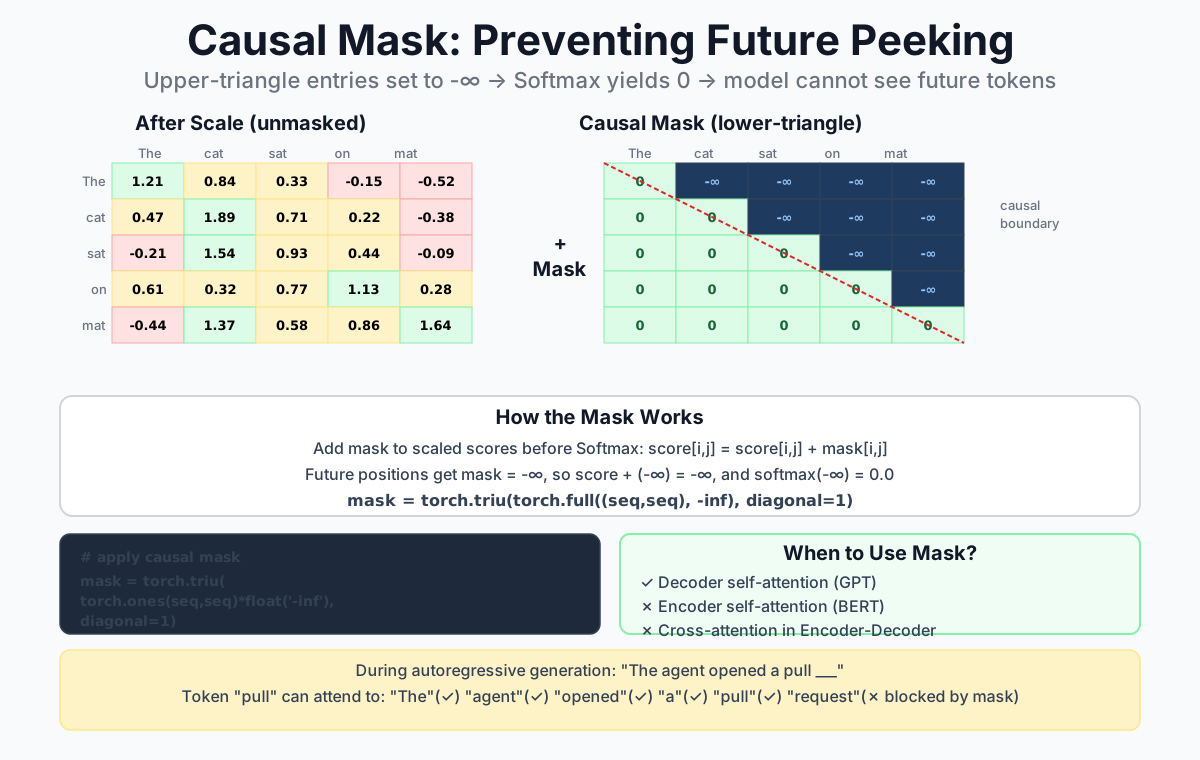
In a GPT-style autoregressive model, predicting the next token must not use future tokens. Q @ K computes raw scores for all position pairs, so a causal mask must block the future pairs. Other architectures may also use padding or structural masks.
Think of it this way: if a model is training on “The luthier carried the theorbo and repaired it,” it must not, when processing “repaired,” be able to see the later token “it.”
10.6.2 How the Mask Works
The solution is a triangular mask that fills future positions with negative infinity:
Before mask:                     After mask:
[0.3, 0.2, 0.1, 0.4]     →     [0.3, -inf, -inf, -inf]
[0.2, 0.5, 0.2, 0.1]     →     [0.2, 0.5,  -inf, -inf]
[0.1, 0.3, 0.4, 0.2]     →     [0.1, 0.3,  0.4,  -inf]
[0.2, 0.1, 0.3, 0.4]     →     [0.2, 0.1,  0.3,  0.4 ]
The upper-right triangle (future positions) becomes -inf.
10.6.3 Why -inf?
Because Softmax maps -inf to exactly 0:
Softmax([0.3, -inf, -inf, -inf]) = [1.0, 0.0, 0.0, 0.0]After Softmax, future positions carry zero weight. The model cannot read from them.
10.7 Softmax: Converting Scores to Weights
10.7.1 The Conversion
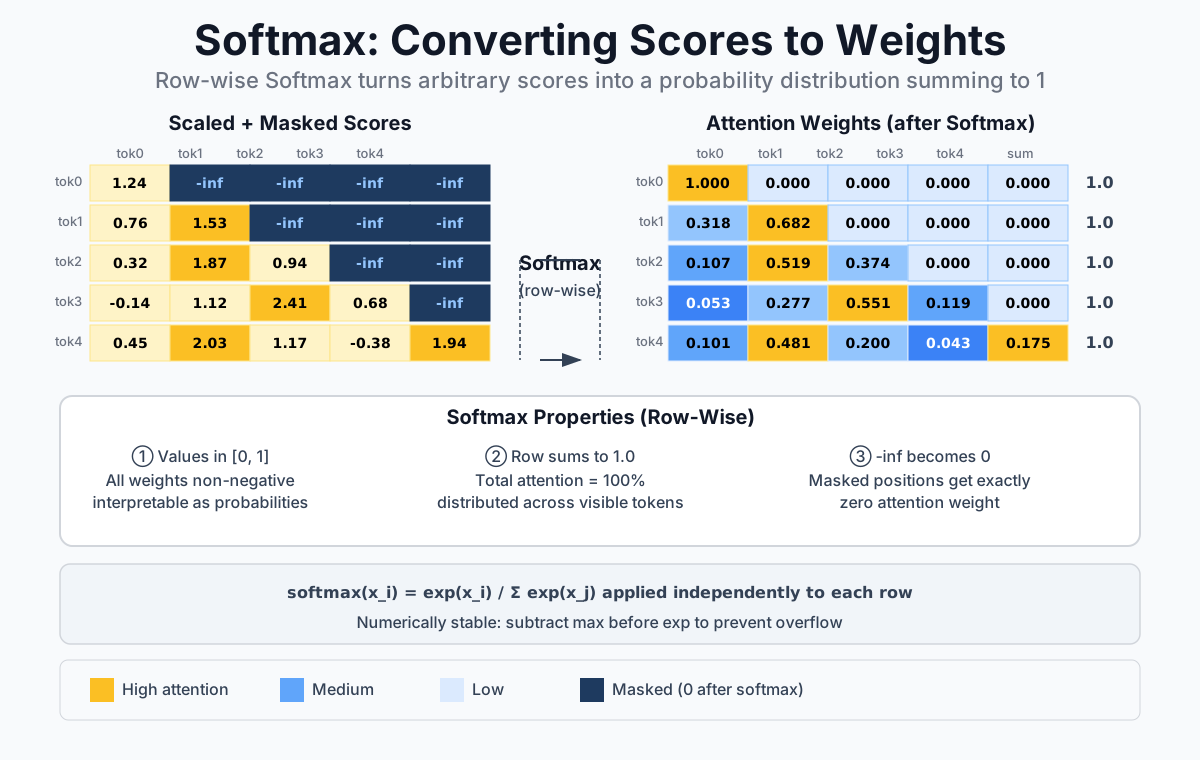
After masking, we apply Softmax row-by-row:
Before Softmax: [0.32, 1.87, 0.94, -inf]
After Softmax:  [0.132, 0.622, 0.246, 0.000]
10.7.2 What Softmax Does
- Normalizes: each row sums to 1
- Preserves score ordering: larger scores receive larger weights, with ratios determined exponentially
- Handles -inf: maps them to exactly 0
10.7.3 Reading the Pattern
For the first token in a causal sequence, it can only attend to itself, so its row becomes [1.00, 0.00, 0.00, ...]. The second token can attend to positions 0 and 1, so its row might look like [0.32, 0.68, 0.00, ...]. Later tokens have more available positions, but a learned head may still concentrate most weight on only one or two of them.
This is the attention weight matrix: the row-wise coefficients used to mix allowed Value vectors. They are not probabilities that a token is semantically relevant.
10.8 Second Matrix Multiplication: Attention Weights @ V
10.8.1 Weighted Sum
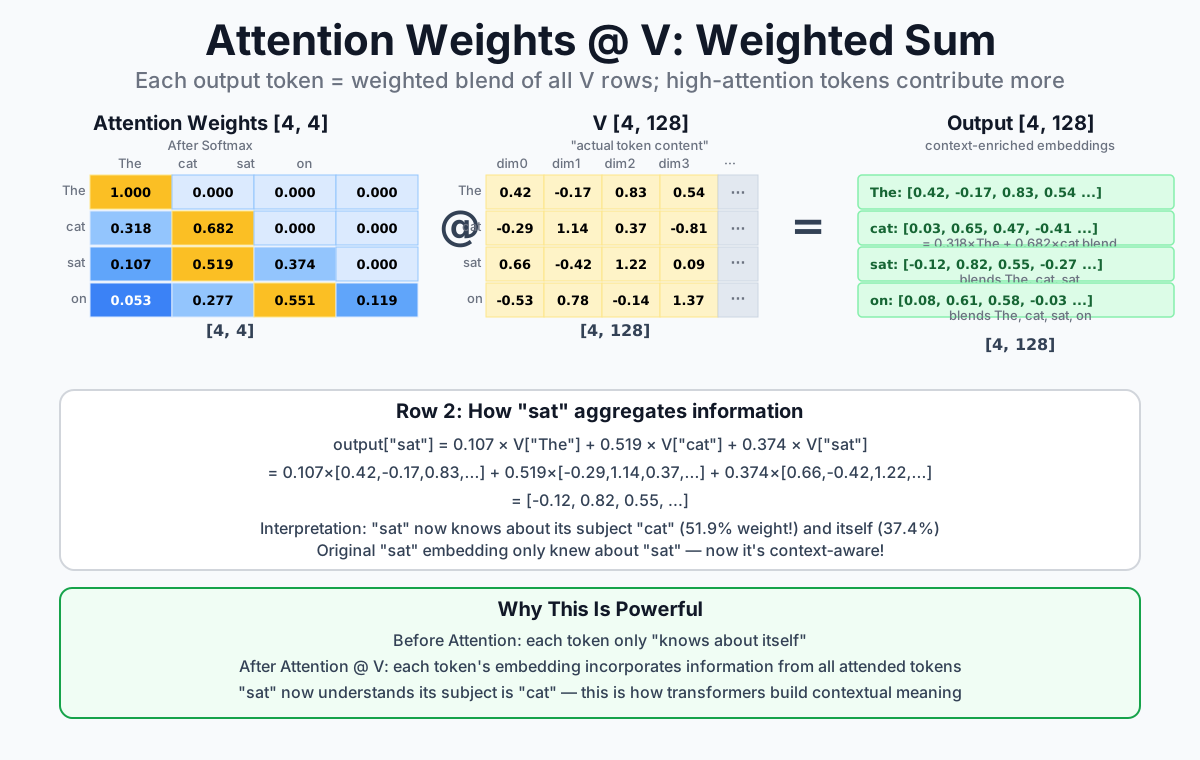
With the attention weights computed, the final step is using them to blend the value vectors:
Output = Attention_Weights @ V10.8.2 Dimension Change
Attention_Weights: [4, 4, 16, 16]   (batch, heads, ctx_len, ctx_len)
V:                 [4, 4, 16, 128]  (batch, heads, key_seq, d_v)
head_output:       [4, 4, 16, 128]  (batch, heads, query_seq, d_v)
The multi-head structure here (4 heads) is the topic of the next chapter.
10.8.3 What This Step Does
Each output position is a weighted sum of the allowed V rows, where the weights come from row-wise Softmax:
output[i] = sum(attention_weight[i, j] × V[j])If token i puts 70% of its attention on token j and 30% on token k:
output[i] = 0.7 × V[j] + 0.3 × V[k]The output is a context-aware blend, not a copy of any single token.
10.9 What the Attention Output Means
10.9.1 Output Dimensions
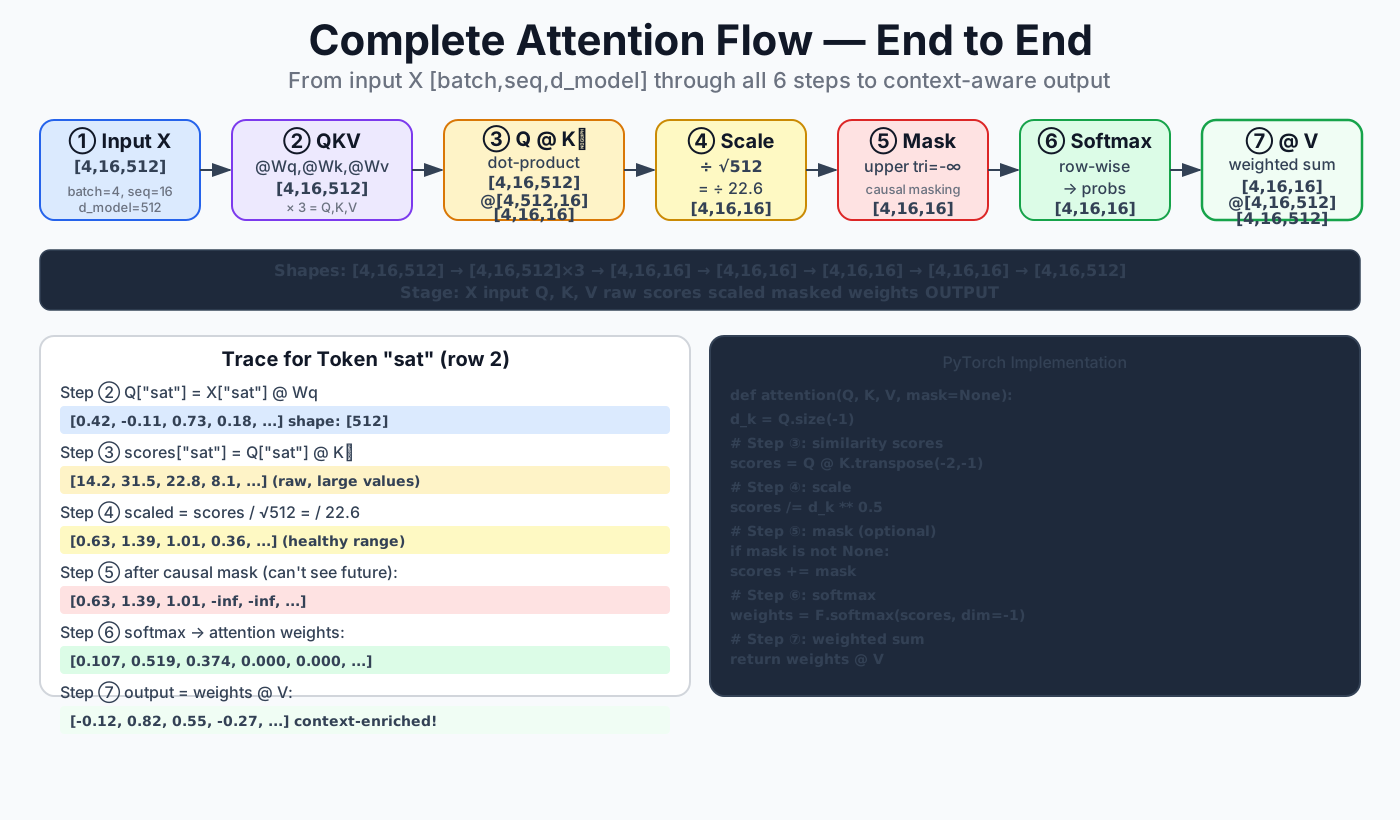
After one head computes weights @ V, each position has a per-head output vector:
head_output: [batch_size, ctx_length, d_v] = [4, 16, 128]Across four heads, those outputs are concatenated to [4, 16, 512] and then projected by W_O back to d_model. Chapter 11 opens up that merge.
10.9.2 The Semantic Shift
Here is the important part. In the first block, X starts from token and position information. In later blocks, X is already contextual. An Attention head adds a new weighted mixture of the allowed projected V rows.
For example, the position for “repaired” can receive projected information from earlier positions such as “luthier” and “theorbo.” The learned weights determine how much each allowed V row contributes.
This is one mechanism by which the model builds contextual representations. It is not a literal proof that a particular head resolved the subject or “understood” the sentence.
10.9.3 The Loop
After the per-head outputs are concatenated and projected through W_O, the Attention branch is combined with the residual stream. The resulting representation then continues to the next sub-layer and is refined block by block.
Each block adds more context into each token's representation.
10.10 The Full Attention Computation
10.10.1 Step-by-Step
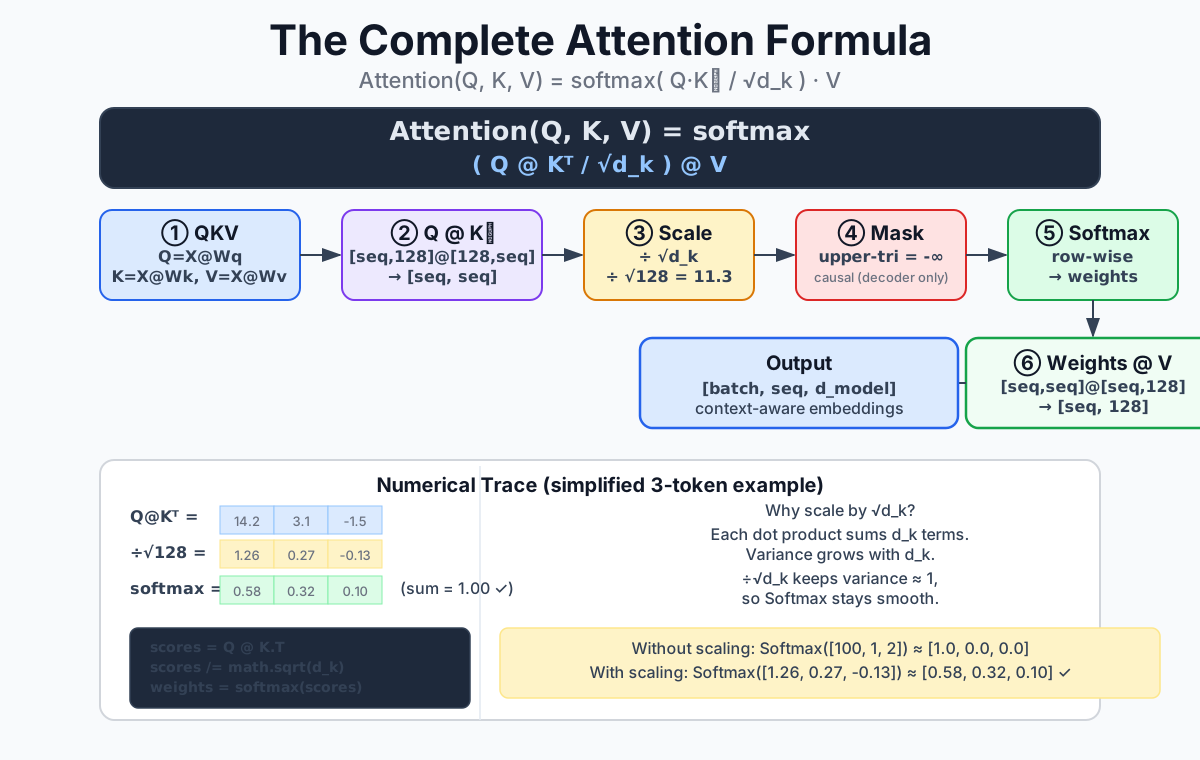
Step 1: Generate combined Q, K, V
        Q = X @ W_Q    [4, 16, 512]
        K = X @ W_K    [4, 16, 512]
        V = X @ W_V    [4, 16, 512]
              ↓
        Reshape into heads (4 heads, d_k = d_v = 128 in this example)
        Q, K: [4, 4, 16, 128]   V: [4, 4, 16, 128]
              ↓
Step 2: Compute compatibility scores (per head)
        scores = Q @ K^T    [4, 4, 16, 16]
              ↓
Step 3: Scale
        scores = scores / sqrt(d_k)    [4, 4, 16, 16]
              ↓
Step 4: Add mask M (causal and/or padding, when required)
        scores = scores + M    [4, 4, 16, 16]
              ↓
Step 5: Softmax
        weights = softmax(scores)    [4, 4, 16, 16]
              ↓
Step 6: Weighted sum (per head)
        head_output = weights @ V    [4, 4, 16, 128]
              ↓
        Concat heads: [4, 16, 512]
        output = concat @ W_O: [4, 16, 512]   (batch, seq, d_model)
10.10.2 PyTorch Implementation
import torch
import torch.nn.functional as F

def attention(Q, K, V, allowed_mask=None):
    """
    Scaled Dot-Product Attention.

    Q: [..., query_len, d_k]
    K: [..., key_len, d_k]
    V: [..., key_len, d_v]
    allowed_mask: boolean tensor broadcastable to
                  [..., query_len, key_len]; True means readable

    Returns:
        output: [..., query_len, d_v]
        attention_weights: [..., query_len, key_len]
    """
    d_k = Q.size(-1)

    # Step 2: Q @ K^T
    scores = torch.matmul(Q, K.transpose(-2, -1))

    # Step 3: Scale
    scores = scores / (d_k ** 0.5)

    # Step 4: Mask
    if allowed_mask is not None:
        # Every query row must retain at least one readable Key.
        scores = scores.masked_fill(~allowed_mask, float('-inf'))

    # Step 5: Softmax
    attention_weights = F.softmax(scores, dim=-1)

    # Step 6: Weighted sum
    output = torch.matmul(attention_weights, V)

    return output, attention_weights
10.11 Deeper Understanding of Q, K, and V
10.11.1 Role Summary
| Role | Generated by | Purpose | Used in |
|---|---|---|---|
| Q | X @ W_Q | "What I am looking for" | Q @ K^T |
| K | X @ W_K | "What I advertise" | Q @ K^T |
| V | X @ W_V | "What I carry" | weights @ V |
10.11.2 Why Separate K from V?
K and V both come from the same input. Why use two different matrices?
To decouple matching from extraction.
- K controls which positions get attention
- V controls what information flows when attention is given
This separation gives the model flexibility: the features used to decide routing can differ from the features sent along that route. Which Query-Key pairs score highly is learned from data, not fixed by the analogy.
10.11.3 An Example
Consider the hand-built sentence: “The luthier repaired the theorbo.”
When processing “repaired”:
- Q("repaired") may look for “who performed this action?”
- K("luthier") may signal “I am the action's subject”
- V("luthier") carries the luthier position's current projected features
This is an intuition for a pattern a trained head could learn, not a claim that every model or head encodes those exact roles.
10.12 Chapter Summary
10.12.1 Key Concepts
| Concept | Shape | Meaning |
|---|---|---|
| X | [batch, seq, d_model] | Input tensor |
| W_Q / W_K | [d_model, h × d_k] | Learnable Query/Key projections |
| W_V | [d_model, h × d_v] | Learnable Value projection |
| Q, K | [batch, h, seq, d_k] | Per-head Query and Key tensors |
| V | [batch, h, seq, d_v] | Per-head Value tensor |
| Scores | [batch, h, query_seq, key_seq] | Raw compatibility scores |
| Weights | same as Scores | Row-normalized mixing weights after mask + Softmax |
| Head output | [batch, h, query_seq, d_v] | Per-head weighted mixtures of V |
| Block-width output | [batch, seq, d_model] | Concatenated heads projected by W_O |
10.12.2 Computation Flow
X → [W_Q, W_K, W_V] → combined Q, K, V → split into heads
              ↓
        Q @ K^T (compatibility scores)
              ↓
        / sqrt(d_k) (scale)
              ↓
        + M (causal/padding mask when needed)
              ↓
        Softmax (normalize)
              ↓
        @ V (per-head weighted sum)
              ↓
        concat heads → W_O → Output
10.12.3 Core Takeaway
Q, K, and V are the three players in Attention. Q asks, K advertises, and their dot product supplies a learned compatibility score. Scaling, masking, and Softmax turn each row into routing weights; those weights blend V. The result is then merged across heads and projected back into the residual stream.
Chapter Checklist
After this chapter, you should be able to:
- Explain what Q, K, and V each represent.
- Describe how they are generated from the same input X.
- Trace the dimension changes through each step of Attention.
- Explain the causal mask and why it uses -inf.
- Explain why the scale factor exists.
See You in the Next Chapter
That was the QKV path end to end, with the head axis exposed just enough to keep every shape consistent.
Real Transformers run this whole process from multiple angles simultaneously. Chapter 11 explains Multi-Head Attention: how the model looks at relationships in parallel and combines everything back together.