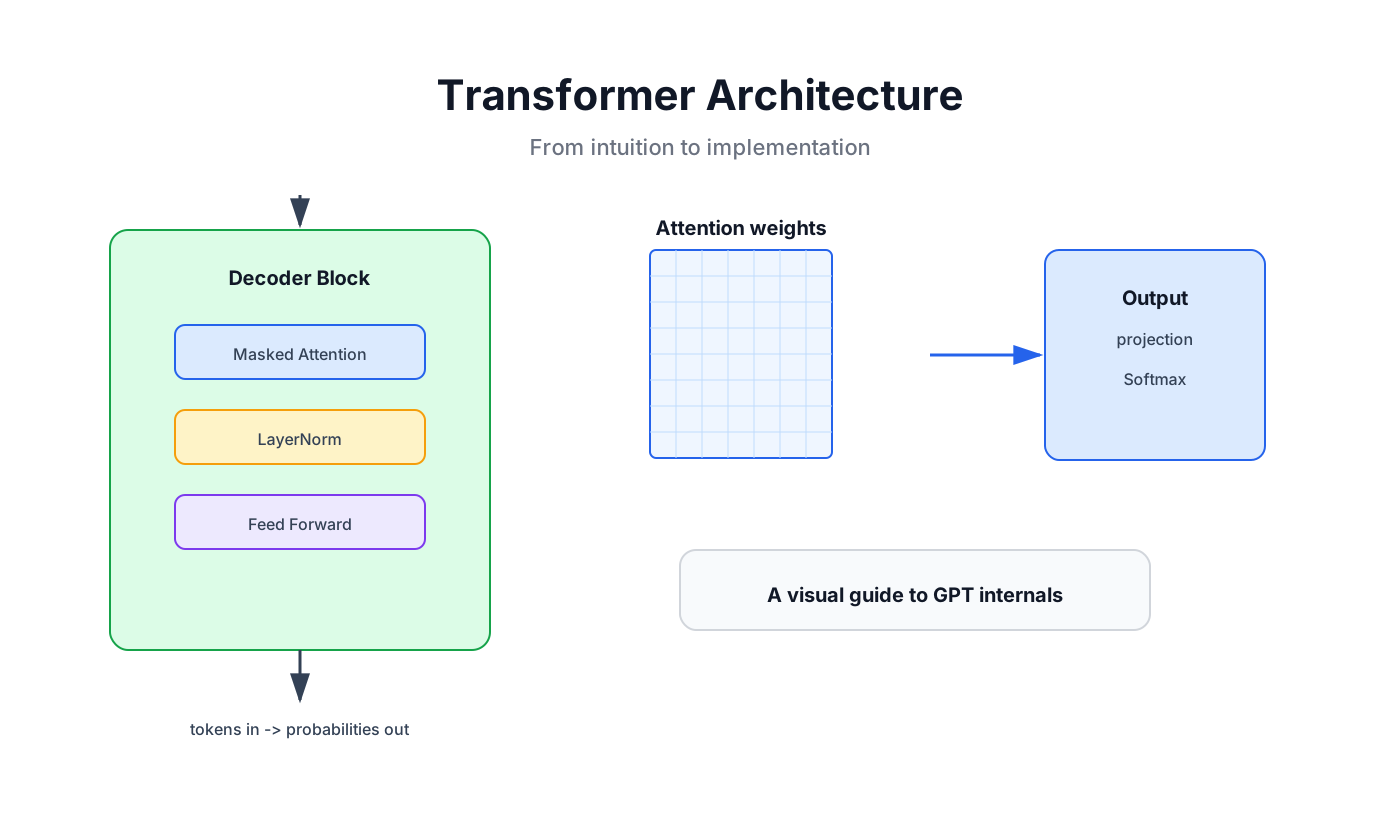
Understand GPT from intuition to code.
Author: Wayland Zhang
This English edition is adapted from the original Chinese Transformer book and video series. It is not a line-by-line translation. The examples, diagrams, and phrasing have been rewritten so the material feels natural to an English-speaking technical reader.
Status: English edition covers the full book: 32 chapters plus appendices. The first pass is complete; the next work is deeper editorial polish and more production anecdotes.
What This Book Is
This book is not about memorizing formulas. It is about understanding what each layer of a Transformer is doing.
Many Transformer tutorials fall into one of three traps:
- They paste formulas before building intuition.
- They repeat the "Attention Is All You Need" paper without unpacking it.
- They copy code without explaining why the code has that shape.
Knowing the words is not the same as understanding the system. Real understanding needs:
- Geometric intuition: why does Q x K measure similarity?
- Visual thinking: how do matrices move information around?
- Concrete analogies: why does generation feel like laying track one token at a time?
- Working code: how do Model, Train, and Inference connect?
Content Overview
| Part | Topic | Chapters |
|---|---|---|
| Part 1 | Build Intuition | Chapters 1-3 |
| Part 2 | Core Components | Chapters 4-7 |
| Part 3 | Attention | Chapters 8-12 |
| Part 4 | Full Architecture | Chapters 13-17 |
| Part 5 | Code Implementation | Chapters 18-20 |
| Part 6 | Production Optimization | Chapters 21-22 |
| Part 7 | Architecture Variants | Chapters 23-25 |
| Part 8 | Deployment and Fine-Tuning | Chapters 26-27 |
| Part 9 | Frontier Progress | Chapters 28-32 |
| Appendix | Compute, decoding, FAQ | Appendices A-C |
Who This Is For
| Reader | What you get |
|---|---|
| ML engineers | A clearer mental model of the architecture you use every day |
| Backend and full-stack engineers | A path from API usage to understanding LLM internals |
| Product and technical leaders | Better intuition about model capabilities and limits |
| CS students | A structured way to connect papers, diagrams, and code |
Prerequisites
- Required: basic Python and matrix multiplication
- Helpful: PyTorch and neural network basics
- Not required: having read "Attention Is All You Need"
Reading Path
- Read the preface to understand the teaching style.
- Read Parts 1-4 in order if Transformer still feels blurry.
- Jump to Parts 6-8 if you already know the architecture and want production optimization.
- Use Part 9 as a map of what changed after the original GPT-style story became mainstream.
License
MIT License - free to read, learn from, and share.
"The best way to learn is to teach."