Lesson 21: Project Implementation
Goal: Integrate knowledge from the first 20 lessons to build a runnable multi-agent trading system prototype from scratch.
Project Overview
This lesson will guide you through building an end-to-end multi-agent trading system. This is not a toy project, but a framework that can be extended into a real trading system.
System Goals
| Dimension | Goal | Non-Goal |
|---|---|---|
| Function | Identify market regime, generate signals, control risk, execute trades | High-frequency trading, complex derivatives |
| Market | US stock daily frequency strategy | Sub-minute strategies |
| Scale | Portfolio of 10-50 stocks | Stock selection from thousands |
| Operation | Local development environment + paper trading | Direct live trading |
Final Deliverables
multi-agent-trading-system/
├── agents/
│   ├── regime_agent.py      # Market regime detection
│   ├── signal_agent.py      # Signal generation
│   ├── risk_agent.py        # Risk control
│   ├── execution_agent.py   # Order execution
│   └── monitor_agent.py     # System monitoring
├── core/
│   ├── data_manager.py      # Data management
│   ├── portfolio.py         # Portfolio management
│   └── order.py             # Order model
├── strategies/
│   ├── momentum.py          # Momentum strategy
│   └── mean_revert.py       # Mean reversion strategy
├── config/
│   └── settings.yaml        # Configuration file
├── tests/
│   └── ...                  # Test cases
└── main.py                  # Entry point
21.1 System Architecture
Overall Architecture Diagram
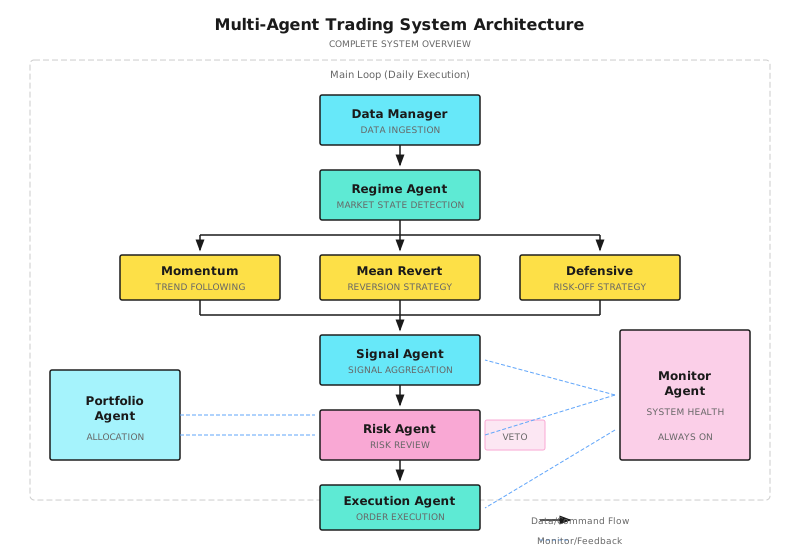
Data Flow
Market Data ---------> Data Manager ---------> All Agents
                         |
                         v
Positions/Balance <---- Portfolio <---------- Execution Agent
                         |
                         v
Logs/Metrics --------> Monitor Agent --------> Alerts
Modular Monolith First
The architecture diagram above shows distinct agents with clean boundaries. A common mistake is to immediately deploy each agent as a separate microservice with its own process, message queue, and database. Don't do this.
Start with a modular monolith: a single process with clean module boundaries and shared Protobuf contracts between modules.
The agents above are logical separations, not deployment boundaries. In your first version, regime_agent.py, signal_agent.py, risk_agent.py, and execution_agent.py all run in the same process, communicating through function calls with well-defined data contracts (dataclasses or Protobuf messages).
Extract to separate services only when:
- Scaling requires independent deployment (e.g., signal research needs GPU but execution does not)
- Different components have fundamentally different latency tiers (e.g., risk checks in Rust at sub-millisecond vs. research in Python at seconds)
- Team size requires independent release cycles
The key insight: module boundaries are a design decision; service boundaries are an infrastructure decision. Get the design right first. Splitting too early adds network latency, distributed debugging complexity, and operational overhead -- none of which help you validate whether your strategy works.
21.2 Step-by-Step Implementation
Step 1: Data Manager
Goal: Fetch and manage market data.
Data Manager Responsibilities:
- Fetch historical quotes (for backtesting)
- Fetch real-time quotes (for live trading)
- Data cleaning and standardization
- Calculate technical indicators
Paper Design: Data Interface
| Method | Input | Output | Purpose |
|---|---|---|---|
get_history | symbol, days | DataFrame | Fetch historical data |
get_latest | symbols | Dict | Fetch latest prices |
calculate_indicators | df | df with indicators | Calculate technical indicators |
validate | df | bool, errors | Data quality check |
Code Framework (Engineer Reference)
import yfinance as yf
import pandas as pd
import numpy as np
from typing import List, Dict, Optional

class DataManager:
    """Data Manager"""

    def __init__(self, cache_dir: str = "./data_cache"):
        self.cache_dir = cache_dir

    def get_history(
        self,
        symbol: str,
        days: int = 252,
        end_date: Optional[str] = None
    ) -> pd.DataFrame:
        """Fetch historical market data"""
        ticker = yf.Ticker(symbol)
        df = ticker.history(period=f"{days}d")

        # Standardize column names
        df = df.rename(columns={
            "Open": "open",
            "High": "high",
            "Low": "low",
            "Close": "close",
            "Volume": "volume"
        })

        return df[["open", "high", "low", "close", "volume"]]

    def calculate_indicators(self, df: pd.DataFrame) -> pd.DataFrame:
        """Calculate technical indicators"""
        # Moving averages
        df["sma_20"] = df["close"].rolling(20).mean()
        df["sma_50"] = df["close"].rolling(50).mean()

        # Volatility
        df["volatility"] = df["close"].pct_change().rolling(20).std() * np.sqrt(252)

        # RSI
        delta = df["close"].diff()
        gain = delta.where(delta >0, 0).rolling(14).mean()
        loss = (-delta.where(delta < 0, 0)).rolling(14).mean()
        df["rsi"] = 100 - (100 / (1 + gain / loss))

        # ATR
        high_low = df["high"] - df["low"]
        high_close = (df["high"] - df["close"].shift()).abs()
        low_close = (df["low"] - df["close"].shift()).abs()
        tr = pd.concat([high_low, high_close, low_close], axis=1).max(axis=1)
        df["atr"] = tr.rolling(14).mean()

        return df

    def validate(self, df: pd.DataFrame) -> tuple:
        """Data quality check"""
        errors = []

        if df.empty:
            errors.append("DataFrame is empty")

        if df["close"].isnull().any():
            errors.append(f"Missing close prices: {df['close'].isnull().sum()}")

        if (df["close"] <= 0).any():
            errors.append("Invalid prices (<=0)")

        return len(errors) == 0, errors
Step 2: Regime Agent
Goal: Identify current market regime.
Regime Agent Output:
- regime: "trending" | "mean_reverting" | "crisis" | "uncertain"
- confidence: 0.0 - 1.0
- regime_weights: {"trending": 0.6, "mean_reverting": 0.3, "crisis": 0.1}
Paper Design: Regime Detection Rules
| Condition | State | Weight Allocation |
|---|---|---|
| ADX >25 and Vol < 25% | Trending | Trend 80%, Mean reversion 15%, Defensive 5% |
| ADX < 20 and Vol < 20% | Range-bound | Trend 20%, Mean reversion 70%, Defensive 10% |
| Vol >30% and Corr >0.7 | Crisis | Trend 10%, Mean reversion 10%, Defensive 80% |
| Other | Uncertain | 33% each |
Code Framework (Engineer Reference)
from dataclasses import dataclass
from typing import Dict

@dataclass
class RegimeState:
    regime: str
    confidence: float
    weights: Dict[str, float]

class RegimeAgent:
    """Market Regime Detection Agent"""

    def __init__(self, config: dict = None):
        self.config = config or {}
        self.adx_threshold = self.config.get("adx_threshold", 25)
        self.vol_crisis = self.config.get("vol_crisis", 0.30)

    def detect(self, market_data: dict) -> RegimeState:
        """
        Detect market regime

        market_data: {
            "adx": float,
            "volatility": float,
            "correlation": float,
            "trend_strength": float
        }
        """
        adx = market_data.get("adx", 20)
        vol = market_data.get("volatility", 0.15)
        corr = market_data.get("correlation", 0.5)

        # Crisis detection takes priority
        if vol > self.vol_crisis and corr >0.7:
            return RegimeState(
                regime="crisis",
                confidence=0.8,
                weights={"momentum": 0.1, "mean_revert": 0.1, "defensive": 0.8}
            )

        # Trend detection
        if adx > self.adx_threshold and vol < 0.25:
            return RegimeState(
                regime="trending",
                confidence=0.7,
                weights={"momentum": 0.7, "mean_revert": 0.2, "defensive": 0.1}
            )

        # Range-bound detection
        if adx < 20 and vol < 0.20:
            return RegimeState(
                regime="mean_reverting",
                confidence=0.6,
                weights={"momentum": 0.2, "mean_revert": 0.7, "defensive": 0.1}
            )

        # Uncertain
        return RegimeState(
            regime="uncertain",
            confidence=0.3,
            weights={"momentum": 0.33, "mean_revert": 0.33, "defensive": 0.34}
        )
Step 3: Signal Agent
Goal: Generate trading signals based on strategies.
Signal Agent Output:
- signals: [
    {"symbol": "AAPL", "direction": "long", "strength": 0.7, "source": "momentum"},
    {"symbol": "MSFT", "direction": "short", "strength": 0.5, "source": "mean_revert"}
  ]
Paper Design: Signal Aggregation Logic
| Scenario | Handling |
|---|---|
| Single strategy signal | Direct output, strength = strategy signal x regime weight |
| Multiple strategies agree | Enhance signal strength, take weighted average |
| Multiple strategies conflict | Take higher-weighted strategy, or don't trade |
Code Framework (Engineer Reference)
from dataclasses import dataclass
from typing import List, Optional

@dataclass
class Signal:
    symbol: str
    direction: str  # "long" | "short" | "close"
    strength: float  # 0.0 - 1.0
    source: str
    timestamp: str

class SignalAgent:
    """Signal Generation Agent"""

    def __init__(self, strategies: list):
        self.strategies = strategies

    def generate_signals(
        self,
        market_data: dict,
        regime_weights: dict
    ) -> List[Signal]:
        """Aggregate signals from all strategies"""
        all_signals = {}

        for strategy in self.strategies:
            strategy_name = strategy.name
            weight = regime_weights.get(strategy_name, 0.33)

            raw_signals = strategy.generate(market_data)

            for sig in raw_signals:
                key = (sig.symbol, sig.direction)
                weighted_strength = sig.strength * weight

                if key in all_signals:
                    # Same direction signals stack
                    all_signals[key].strength += weighted_strength
                else:
                    all_signals[key] = Signal(
                        symbol=sig.symbol,
                        direction=sig.direction,
                        strength=weighted_strength,
                        source=strategy_name,
                        timestamp=sig.timestamp
                    )

        # Filter weak signals
        return [s for s in all_signals.values() if s.strength >0.3]
Step 4: Risk Agent
Goal: Review signals, control risk.
Risk Agent Decisions:
- APPROVE: Pass, can execute
- REDUCE: Pass but reduce position size
- REJECT: Reject
Paper Design: Review Rules
| Rule | Check Content | Trigger Action |
|---|---|---|
| Single trade limit | Position >10% | Reduce to 10% |
| Symbol limit | Same symbol >20% | Reject or reduce |
| Total position limit | Total exposure >80% | Reject |
| Drawdown control | Current drawdown >10% | Reject all new positions |
| Circuit breaker | Drawdown >15% | Force deleverage |
Code Framework (Engineer Reference)
from enum import Enum
from dataclasses import dataclass
from typing import Optional

class Decision(Enum):
    APPROVE = "approve"
    REDUCE = "reduce"
    REJECT = "reject"

@dataclass
class RiskDecision:
    decision: Decision
    reason: str
    adjusted_size: Optional[float] = None

class RiskAgent:
    """Risk Control Agent"""

    def __init__(self, config: dict):
        self.max_single = config.get("max_single_position", 0.10)
        self.max_symbol = config.get("max_symbol_exposure", 0.20)
        self.max_total = config.get("max_total_exposure", 0.80)
        self.drawdown_stop = config.get("drawdown_stop", 0.10)
        self.drawdown_circuit = config.get("drawdown_circuit", 0.15)

    def check(
        self,
        signal: Signal,
        proposed_size: float,
        portfolio: dict,
        current_drawdown: float
    ) -> RiskDecision:
        """Review trading signal"""

        # Circuit breaker check
        if current_drawdown >= self.drawdown_circuit:
            return RiskDecision(Decision.REJECT, "Circuit breaker active")

        # Drawdown control
        if current_drawdown >= self.drawdown_stop:
            if signal.direction != "close":
                return RiskDecision(Decision.REJECT, "Drawdown limit reached")

        # Single trade limit
        if proposed_size > self.max_single:
            return RiskDecision(
                Decision.REDUCE,
                f"Size exceeds single limit",
                adjusted_size=self.max_single
            )

        # Symbol limit
        current_exposure = portfolio.get(signal.symbol, 0)
        if current_exposure + proposed_size > self.max_symbol:
            allowed = self.max_symbol - current_exposure
            if allowed <= 0:
                return RiskDecision(Decision.REJECT, "Symbol limit reached")
            return RiskDecision(
                Decision.REDUCE,
                "Symbol limit",
                adjusted_size=allowed
            )

        # Total exposure limit
        total_exposure = sum(portfolio.values()) + proposed_size
        if total_exposure > self.max_total:
            return RiskDecision(Decision.REJECT, "Total exposure limit")

        return RiskDecision(Decision.APPROVE, "Passed all checks")
Step 5: Execution Agent
Goal: Execute trading orders.
Execution Agent Responsibilities:
- Convert signals to orders
- Select order type (market/limit)
- Manage order status
- Record execution results
Code Framework (Engineer Reference)
from dataclasses import dataclass
from enum import Enum
from datetime import datetime
import uuid

class OrderStatus(Enum):
    PENDING = "pending"
    SUBMITTED = "submitted"
    FILLED = "filled"
    CANCELLED = "cancelled"
    REJECTED = "rejected"

@dataclass
class Order:
    order_id: str
    symbol: str
    side: str  # "buy" | "sell"
    quantity: int
    order_type: str  # "market" | "limit"
    limit_price: float = None
    status: OrderStatus = OrderStatus.PENDING
    filled_price: float = None
    filled_time: str = None

class ExecutionAgent:
    """Order Execution Agent"""

    def __init__(self, broker_client=None, is_paper: bool = True):
        self.broker = broker_client
        self.is_paper = is_paper
        self.orders = {}

    def create_order(
        self,
        symbol: str,
        direction: str,
        size: float,
        portfolio_value: float,
        current_price: float
    ) -> Order:
        """Create order"""
        # Calculate share count
        dollar_amount = portfolio_value * size
        quantity = int(dollar_amount / current_price)

        if quantity <= 0:
            return None

        side = "buy" if direction == "long" else "sell"

        order = Order(
            order_id=str(uuid.uuid4())[:8],
            symbol=symbol,
            side=side,
            quantity=quantity,
            order_type="market"
        )

        self.orders[order.order_id] = order
        return order

    def submit_order(self, order: Order) -> bool:
        """Submit order"""
        if self.is_paper:
            # Simulate fill
            order.status = OrderStatus.FILLED
            order.filled_time = datetime.now().isoformat()
            # Paper trading assumes fill at current price
            return True

        # Live trading calls broker API
        # response = self.broker.submit_order(order)
        # ...
        return True
Step 6: Main Loop
Goal: Connect all Agents together.
# Main loop pseudocode
def main_loop():
    # 1. Get data
    market_data = data_manager.get_latest(symbols)

    # 2. Detect regime
    regime_state = regime_agent.detect(market_data)

    # 3. Generate signals
    signals = signal_agent.generate(market_data, regime_state.weights)

    # 4. Risk review
    for signal in signals:
        proposed_size = calculate_position_size(signal)
        decision = risk_agent.check(signal, proposed_size, portfolio, drawdown)

        if decision.decision == Decision.APPROVE:
            size = proposed_size
        elif decision.decision == Decision.REDUCE:
            size = decision.adjusted_size
        else:
            continue

        # 5. Execute order
        order = execution_agent.create_order(
            signal.symbol, signal.direction, size, portfolio_value, current_price
        )
        execution_agent.submit_order(order)

    # 6. Update portfolio
    portfolio.update()

    # 7. Log
    monitor_agent.log_daily_summary()
From Teaching Code to Production Systems
This lesson implements all agents in Python for accessibility. In production, different components typically use different languages based on their latency requirements:
- Risk Engine -- Rust (immutable hardcoded limits, nanosecond latency)
- Order Management -- Go (high concurrency, goroutine model)
- Research/ML -- Python (rich ML ecosystem)
The key is not the language choice -- it is clean module boundaries and standardized communication protocols (e.g., gRPC + Protobuf). If your Python prototype has well-defined interfaces between agents, migrating performance-critical paths to Rust or Go later is a refactor, not a rewrite.
21.3 Backtest Validation
Backtesting Framework
Backtesting is not to prove the strategy works, but to discover the strategy's problems.
Backtest Checklist (Reference Lesson 7 Quality Gate):
| Check Item | Pass Criteria |
|---|---|
| No look-ahead bias | All data available at T+1 |
| Realistic cost modeling | Includes slippage, commission |
| Out-of-sample validation | OOS Sharpe > IS Sharpe x 0.7 |
| Parameter stability | Strategy doesn't collapse with parameters +/-20% |
| Extreme scenario testing | Test 2008, 2020 separately |
Key Backtest Metrics
| Metric | Target | Warning Level |
|---|---|---|
| Annual Return | >15% | < 10% |
| Sharpe Ratio | >1.0 | < 0.5 |
| Max Drawdown | < 20% | >30% |
| Win Rate | >50% | < 40% |
| Profit/Loss Ratio | >1.5 | < 1.0 |
| Turnover | < 500%/year | >1000%/year |
21.4 From Paper to Live Trading
Staged Validation
Stage 1: Historical Backtest (2-4 weeks)
├── Validate strategy logic is correct
├── Validate system can run completely
└── Goal: Backtest metrics meet standards

Stage 2: Paper Trading (2-4 weeks)
├── Use real quotes, fake trades
├── Validate real-time data processing
└── Goal: Execution error-free

Stage 3: Small Capital Live (4-8 weeks)
├── Deploy 5-10% of planned capital
├── Validate real execution
└── Goal: Live performance close to backtest

Stage 4: Gradual Scale-Up (Ongoing)
├── Monthly evaluation, gradually increase capital
├── Continuous monitoring and tuning
└── Goal: Stable profitability
Pre-Live Checklist
[ ] System Check
  +-- All Agent processes stable running >1 week
  +-- Alert system tested
  +-- Logging complete
  +-- Disaster recovery process verified

[ ] Strategy Check
  +-- Backtest passed Quality Gate
  +-- Paper trading >2 weeks
  +-- Slippage estimates reasonable
  +-- Extreme scenario contingency plans

[ ] Operations Check
  +-- Pre/post-market checklists ready
  +-- Contact info updated
  +-- Backup plans prepared
  +-- Capital transfer confirmed

[ ] Mental Preparation
  +-- Clear on risk tolerance
  +-- Set clear stop-loss line
  +-- Ready to face drawdowns
21.5 Project Extension Directions
Optional Enhancements
| Direction | Description | Complexity |
|---|---|---|
| Multi-market | Support A-shares, HK stocks, crypto | Medium |
| Multi-timeframe | Support minute-level strategies | High |
| LLM Integration | News analysis, research report parsing | Medium |
| Online Learning | Strategy auto-evolution | High |
| Web Interface | Visual monitoring | Medium |
| Distributed Deployment | Multi-server operation | High |
Continuous Improvement Cycle
+------------------------------------------------------------+
|                                                            |
|    Monitor ------> Discover Issues ------> Analyze Cause   |
|      ^                                          |          |
|      |                                          v          |
|    Deploy <------- Test Validate <------- Improvement Plan |
|                                                            |
+------------------------------------------------------------+
21.6 Research Contract and Backtest-to-Live Promotion
Freeze the Research Contract First
Before the final evaluation, write a versioned contract containing:
- hypothesis, economic mechanism, universe, holding period, and invalidation condition;
- point-in-time data snapshot, lineage, calendars, time zones, corporate-action policy, and feature availability timestamps;
- signal, sizing, risk, and execution assumptions, including spreads, fees, impact, borrow, financing, FX, and capacity;
- train/validation/final-holdout boundaries, purge or embargo rules where labels overlap, primary metric, uncertainty method, and pass/fail gates;
- trial count, random seeds, environment and code versions, artifact hashes, and the rule for any permitted rerun.
Freeze the contract before the final holdout is opened. Record both GO and NO GO outcomes in an append-only ledger. If a premise later changes, create a new experiment version; never relabel the old result.
Keep a Minimal Evidence Bundle
The durable bundle needs the contract, data/code identifiers and hashes, validation report, cost assumptions, gate verdicts, and a machine-readable run manifest. It does not need proprietary strategy code, features, parameters, positions, returns, broker credentials, or production topology. Public examples should use synthetic identifiers and values.
Promotion Ladder
| Stage | What It Proves | What It Does Not Prove |
|---|---|---|
| Deterministic replay and unit tests | Data timing, accounting, state transitions, reproducibility | Economic edge |
| Walk-forward backtest + untouched holdout | Historical evidence under frozen assumptions | Future fills or regime stability |
| Shadow mode | Live inputs and generated intents behave as expected | Order handling or fill quality |
| Paper trading | Broker wiring, order lifecycle, permissions, recovery | Queue position, impact, borrow, live fills |
| Deliberately limited live stage | Real fees, fills, reconciliation, and operational behavior under a separately approved risk budget | Scalability or long-run alpha |
| Gradual scale | Capacity evidence gathered under explicit gates | Unlimited capacity |
Use the same typed data contracts, intent schema, risk rules, order state machine, currencies, calendars, and fee semantics across stages. Keep three proofs separate: local code-path proof, runtime/configuration parity, and post-run external reconciliation. A successful backtest does not establish the latter two.
Acceptance Criteria
Project Acceptance Checklist
| Stage | Criterion | Pass Standard |
|---|---|---|
| Code | System runs | python main.py no errors |
| All Agents work | Logs show Agent outputs | |
| Config modifiable | Changes to settings.yaml take effect | |
| Backtest | Backtest runs | Generates backtest report |
| Metrics calculated correctly | Manually verify 2-3 trades | |
| No obvious bugs | Backtest curve reasonable | |
| Paper Trading | Can get real-time data | Logs show latest prices |
| Can generate signals | Signal list not empty | |
| Risk controls work | Over-limit orders rejected | |
| Documentation | Has README | Others can understand how to run |
| Has config documentation | Parameter meanings clear |
Self-Assessment Questions
After completing the project, answer these questions:
- In what market regime does your system perform best/worst?
- What caused the largest drawdown?
- If going live tomorrow, what worries you most?
- What aspects of the system can still be improved?
Lesson Deliverables
After completing this lesson, you will have:
- Complete Code Framework - Runnable multi-agent system
- Backtest Validation Results - Strategy performance evaluation
- Pre-Live Checklist - Path from paper to live trading
- Extension Direction Guide - Ideas for future improvements
Key Takeaways
- Understand overall multi-agent system architecture
- Master each Agent's responsibilities and interface design
- Can integrate knowledge from first 20 lessons into one system
- Understand validation path from backtest to live trading
Further Reading
- Lesson 01: The Complete Landscape of Quantitative Trading - Review the starting point
- Lesson 07: Backtest System Pitfalls - Backtest quality gate
- Lesson 20: Production Operations - Operations best practices
Next Lesson Preview
Lesson 22: Summary and Advanced Directions
This course is about to end. In the final lesson, we'll review the entire learning journey, summarize core insights, and look forward to advanced directions - from personal projects to career development, from technical depth to industry perspective.