Background: Frontier ML and RL Research (2026 Review)
Reviewed in July 2026, this chapter surveys methods discussed in public papers, open-source projects, and company disclosures, mainly from 2024-2025. Publication or public experimentation does not establish production deployment, economic value, or reproducibility. Treat every named method as a research candidate until it passes leakage-safe, net-of-cost validation on your own problem.
1. Technology Evolution Overview
1.1 From Traditional to Frontier
| Generation | Representative Technology | Status |
|---|---|---|
| 1st Gen | Linear Regression, Logistic | Basic, still in use |
| 2nd Gen | LSTM, GRU | Still viable baselines for many sequence tasks |
| 3rd Gen | Transformer, GNN | Active research and selective production use |
| 4th Gen | Foundation Models, Diffusion | Frontier exploration |
Note: LSTM/GRU are not obsolete. They remain reasonable baselines for small datasets or simpler sequence tasks. Latency depends on model size, hardware, runtime, batching, and measurement boundary; benchmark it rather than assuming a fixed number. See Model Architecture Selection Guide for detailed guidance.
1.2 How to Read Institutional Claims
Hiring pages, conference talks, patents, research papers, and infrastructure announcements show areas of interest—not a verified inventory of production strategies. Do not infer a trading model from an affiliated AI project, convert assets under management into "compute investment," or treat a vendor case study as return evidence. For each claim, record the public source, publication date, exact wording, and whether it demonstrates research, tooling, pilot use, or production deployment.
2. Decision Transformer
2.1 Core Idea
Transform reinforcement learning problems into sequence modeling problems:
Traditional RL: State -> Policy -> Action -> Reward -> Update Policy
Decision Transformer: (Return, State, Action) sequence -> Next Action
Key Innovation:
- No need for value function estimation
- No need for policy gradients
- Directly uses Transformer to model "if I want this return, what should I do"
2.2 GPT-2 + LoRA for Trading
Latest Research (November 2024):
Architecture:
Pre-trained GPT-2
    |
LoRA Fine-tuning (Low-Rank Adaptation)
    |
Decision Transformer for Trading
Why It Works:
- GPT-2's pre-trained weights provide powerful sequence modeling capability
- LoRA only fine-tunes a small fraction of parameters (~0.1%), efficient and prevents overfitting
- Suitable for scenarios with scarce financial data
Performance: Competitive with CQL, IQL, BC, and other offline RL algorithms, superior in some scenarios
2.3 TACR (Transformer Actor-Critic with Regularization)
Problem Addressed: Traditional RL assumes Markov property (only looks at current state), but financial markets have long-term dependencies
Method: Uses Decision Transformer's attention mechanism to model historical MDP sequences
Exercise: Implement a simple Decision Transformer trading framework
3. LLM-Driven Alpha Mining
3.1 AlphaAgent Framework
Core Idea: Multi-agent collaboration for alpha factor mining
Architecture:
┌─────────────────────────────────────────────────────┐
│                   AlphaAgent System                  │
├─────────────────────────────────────────────────────┤
│  Research Agent     →  Generate factor hypotheses    │
│       ↓                                              │
│  Backtest Agent     →  Validate factor effectiveness │
│       ↓                                              │
│  Risk Agent         →  Assess factor risk properties │
│       ↓                                              │
│  Portfolio Agent    →  Optimize weights & allocation │
└─────────────────────────────────────────────────────┘
Key Features:
- Multi-agent division: Each agent focuses on a single task, avoiding single LLM capability bottlenecks
- Iterative optimization: Continuous factor improvement through backtest feedback
- Risk-aware: Risk Agent embedded in the workflow, not an afterthought
- Explainability: Clear reasoning chain at each decision node
Comparison with Traditional Methods:
| Feature | Traditional Quant | Single LLM | AlphaAgent |
|---|---|---|---|
| Factor mining efficiency | Low (manual) | Medium | High |
| Risk control | Post-hoc | Weak | Built-in |
| Explainability | High | Low | High |
| Iteration speed | Slow | Fast | Fast |
3.2 LLM-Guided RL
Source: arXiv 2508.02366 (2025)
Core Idea:
LLM: Generate high-level strategy ("Market is in uptrend, suggest overweight tech stocks")
 |
RL Agent: Execute specific trades ("Buy 100 shares AAPL, limit $185")
 |
Reward: Feedback to LLM for strategy improvementAdvantages:
- LLM provides interpretable high-level logic
- RL optimizes low-level execution details
- The two complement each other
Experimental Results: 4 out of 6 stocks showed better Sharpe ratio than pure RL baseline
3.3 Alpha-GPT 2.0
Position: Human-in-the-Loop AI
Process:
- LLM generates factor candidates
- Human experts review/modify
- Backtest validation
- Feedback for improvement
Suitable Scenario: Institutional applications requiring human oversight
Exercise: Implement a simple LLM factor generation pipeline
4. Graph Neural Networks (GNN)
4.1 Why GNN is Needed
Traditional Method Limitations:
- Assumes stocks are independent
- Ignores relational connections
Market Reality:
- Supply chain relationships (Apple -> TSMC)
- Industry correlations (bank stocks move together)
- Macro factors (interest rates affect all stocks)
4.2 Role-Aware Graph Transformer
Source: December 2025 research
Multi-Relationship Modeling:
| Edge Type | Meaning | Construction Method |
|---|---|---|
| Correlation | Price correlation | Historical return correlation coefficient |
| Fundamental | Fundamental similarity | PE, PB, ROE, etc. |
| Sector | Industry relationship | GICS classification |
| Supply Chain | Supply chain | Earnings report disclosure |
Role Awareness:
- Hub Stocks (e.g., AAPL, MSFT): Influence many other stocks
- Bridge Stocks: Connect different industries
- Peripheral Stocks: Passively follow
4.3 TFT-GNN Hybrid Model
Temporal Fusion Transformer + Graph Neural Network
Time Dimension: TFT captures
    |
Relationship Dimension: GNN models
    |
Fusion Layer
    |
PredictionPerformance: MSE reduced by 10.6% (compared to TFT alone)
Exercise: Implement simple stock relationship graph construction and GNN prediction
5. Diffusion Models
5.1 Application Scenarios
| Scenario | Traditional Method | Diffusion Model Advantage |
|---|---|---|
| Synthetic Data Generation | GAN | More stable, no mode collapse |
| Market Simulation | Monte Carlo | More realistic statistical properties |
| LOB Simulation | Rule-based models | Captures complex dynamics |
5.2 TRADES Framework
Source: arXiv 2502.07071 (February 2025)
Position: TRAnsformer-based Denoising Diffusion for LOB Simulations
Architecture:
Limit Order Book State
    |
Transformer Encoder (Captures spatiotemporal features)
    |
DDPM (Denoising Diffusion)
    |
Generated Order FlowPerformance: Predictive Score improved 3.27x (vs SOTA)
Open Source: DeepMarket (First open-source LOB deep learning simulation framework)
5.3 Wavelet + DDPM Method
Source: arXiv 2410.18897
Innovation: Transform time series to images
Multiple Time Series (price, volume, spread)
    |
Wavelet Transform -> Image
    |
DDPM generates new images
    |
Inverse Wavelet Transform -> Synthetic time seriesAdvantages:
- Captures stylized facts of financial data (fat tails, volatility clustering)
- Generation quality superior to GAN
- Can be used for backtest data augmentation
5.4 Application Value
| Application | Description |
|---|---|
| Data Augmentation | Expand scarce historical data |
| Stress Testing | Generate extreme market scenarios |
| Backtest Robustness | Validate strategies across multiple scenarios |
| Privacy Protection | Generate synthetic data to replace real data |
Exercise: Research TRADES framework usability, evaluate integration feasibility
6. Time Series Foundation Models
6.1 Overview
| Model | Developer | Parameters | Features |
|---|---|---|---|
| Chronos-2 | Amazon | 120M | Latest (October 2025) |
| TimeGPT | Nixtla | - | Trained on 100B+ tokens |
| TimesFM | - | - | |
| Moirai | Salesforce | - | - |
6.2 Chronos-2
Release: October 20, 2025
Capabilities:
- Zero-shot forecasting (no fine-tuning needed)
- Univariate / Multivariate / Covariates
- Single architecture supports all scenarios
Downloads: 600M+ (Hugging Face)
6.3 Financial Application Considerations
Research Findings:
- General foundation models have limited effectiveness in finance
- Domain-aligned models (e.g., FinCast) perform better
- Low signal-to-noise ratio of financial data is the main challenge
Recommendations:
- Use as baseline reference
- May need fine-tuning on financial data
- Not recommended for direct production signals
Exercise: Evaluate Chronos-2 zero-shot performance on stock prediction tasks
7. Reinforcement Learning Frontier
7.1 Algorithm Candidate Map (2026 Review)
| Scenario | Candidate Algorithm | Research Question |
|---|---|---|
| Portfolio Allocation | PPO | Does a learned policy beat a constrained optimizer after costs and turnover? |
| Order Execution Research | SAC / offline RL | Can the policy improve a fixed execution benchmark without unsafe online exploration? |
| Discrete Research Actions | DQN | Is the state approximately Markovian and the action space truly discrete? |
| Risk-Sensitive Objectives | Distributional RL | Are tail estimates calibrated under regime shifts? |
7.2 Hybrid Approaches Trend
There is no reliable public census of production RL adoption across quantitative firms. Paper counts, survey respondents, GitHub activity, and real capital deployment measure different things and should not be combined into an "industry adoption rate."
Hybrid Advantages:
| Combination | Application | Evidence to require |
|---|---|---|
| Sequence model + DQN | Portfolio research | Same data split, constraints, costs, and non-RL benchmark |
| CNN + PPO | Crypto research | Exchange-specific fees, latency, capacity, and independent holdout |
| Attention + actor-critic | Market-making research | Queue-aware simulator, adverse-selection model, and replay against a fixed policy |
7.3 IMM (Imitative Market Maker)
Source: IJCAI 2024
Innovation:
- Multi-price level order book modeling
- Imitation learning (learn from expert market makers)
- Integrate expert signals
Application: RL optimization for market making strategies
7.4 FinRL Framework
Position: Open-source standard framework for financial reinforcement learning
Features:
- Standardized environment based on OpenAI Gym
- Integrates DQN, PPO, A3C, SAC, and other algorithms
- Supports backtesting and risk assessment
Recommended Use: Starting point for RL strategy development
Exercise: Evaluate feasibility of FinRL integration into existing framework
8. Multi-Agent Systems
8.1 Dynamic Gating Architecture
Core Idea:
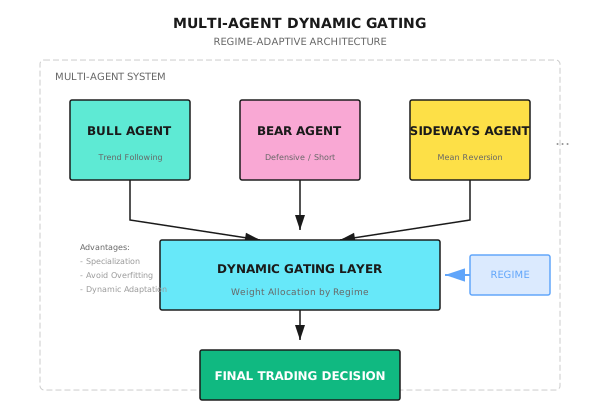
Advantages:
- Each Agent focuses on specific market states
- Avoids single model overfitting
- Dynamically adapts to market changes
8.2 FinMem
Position: LLM trading Agent with hierarchical memory
Memory Structure:
- Short-term Memory: Recent market events
- Working Memory: Current positions and decision context
- Long-term Memory: Historical patterns and lessons learned
8.3 TwinMarket
Source: Yang et al. 2025
Features: Simulates individual behavior and collective dynamics in markets
Applications:
- Research financial bubble formation
- Understand market emergence phenomena
- Test strategy performance in complex markets
Exercise: Research multi-agent gating mechanism implementation
9. Practical Roadmap
9.1 Priority Ranking
| Priority | Technology | Reason |
|---|---|---|
| P0 | LLM-Guided RL | Interpretability + Performance |
| P0 | AlphaAgent | Automated factor mining |
| P1 | GNN Relationship Modeling | Captures market structure |
| P1 | Decision Transformer | Replace traditional RL |
| P2 | Diffusion Models | Data augmentation/stress testing |
| P2 | Time Series Foundation Models | Zero-shot prediction capability |
9.2 Implementation Recommendations
Short-term (1-3 months):
- Evaluate FinRL framework
- Implement simple LLM factor generation pipeline
- Build stock relationship graph
Medium-term (3-6 months):
- Implement Decision Transformer framework
- Integrate GNN for relationship prediction
- Develop multi-agent gating system
Long-term (6-12 months):
- Complete AlphaAgent system
- Diffusion models for data augmentation
- Production-level deployment and monitoring
10. Reference Resources
Papers
- AlphaAgent: Multi-agent alpha factor mining framework
- LLM-Guided RL: arXiv 2508.02366
- Decision Transformer for Trading: arXiv 2411.17900
- TRADES: arXiv 2502.07071
- GNN Survey for Stock: ACM Computing Surveys 2024
- RL in Finance Review: arXiv 2512.10913
Open-Source Frameworks
- FinRL: https://github.com/AI4Finance-Foundation/FinRL
- DeepMarket: (Released with TRADES paper)
- Chronos-2: https://huggingface.co/amazon/chronos-2
- FinGPT: https://github.com/AI4Finance-Foundation/FinGPT
Datasets
- FinRL Contest Dataset
- LOBSTER (Academic LOB data)
Core Principle: Track the frontier, but don't blindly chase the new. Every technology needs validation in your specific scenario, rather than copying paper conclusions. The advantage of leading institutions lies in their ability to fail at scale and iterate, not in using some "magical" model.