Chapter 30: Tiered Model Strategy
"Tiered routing can save 80% costs" -- but only if you can correctly judge task complexity, which is harder than it sounds.
Quick Track (Master the core in 5 minutes)
- Three tiers: Small (50% traffic) -> Medium (40%) -> Large (10%)
- Complexity judgment: Rules first (keywords/length), LLM fallback (fuzzy tasks)
- Upgrade mechanism: Auto-upgrade to Medium/Large when Small output quality is poor
- Cost monitoring: Track token consumption by tier, investigate if Large exceeds 20%
- Cache first: Same queries hitting cache saves more than model tiering
10-Minute Path: 30.1-30.3 -> 30.5 -> Shannon Lab
30.1 Starting with a Bill
Your AI Agent system has been live for three months, and the boss calls you in for a chat:
"This month's LLM bill is $15,000, ten times over budget."
You pull up usage logs and find the problem:
[2025-01-10 09:15:22] User asked: "What day is today?"
                       Model: claude-opus-4-1
                       Cost: 0.12 USD

[2025-01-10 09:15:45] User asked: "Help me analyze the core risk points in this 200-page financial report"
                       Model: claude-opus-4-1
                       Cost: 0.35 USD
Two tasks used the same expensive top-tier model. Asking "what day is today" cost $0.12 -- Haiku could answer that 200 times for the same price.
The core problem: Your system is "over-serving" -- using a Rolls-Royce for grocery delivery, using rocket launchers on mosquitoes.
This chapter solves one problem: How to match the right tasks with the right models.
30.2 Three-Tier Model Architecture
Why Three Tiers?
| Tier | Use Cases | Representative Models | Relative Cost |
|---|---|---|---|
| Small | Simple Q&A, formatting, classification | claude-haiku, gpt-5-nano | 1x |
| Medium | Standard analysis, summarization, code assistance | claude-sonnet, gpt-5-mini | 3-5x |
| Large | Complex reasoning, creative writing, deep analysis | claude-opus, gpt-5.1 | 50-150x |
The three-tier design comes from practical observation -- most production traffic can be categorized into these three buckets:
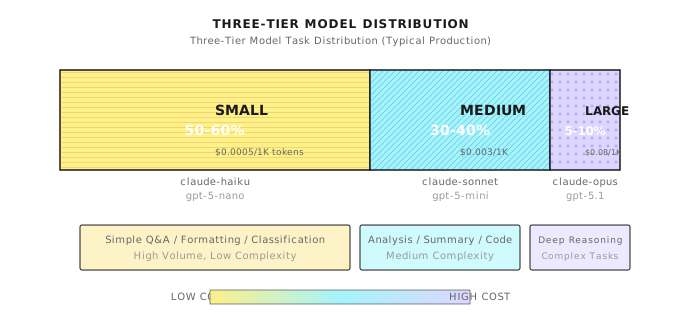
Target distribution: 50% Small / 40% Medium / 10% Large.
This isn't a mandatory quota -- it's a reference baseline. Actual distribution depends on your business scenario. But if your Large exceeds 20%, your complexity judgment might have issues.
Configuration Structure
Implementation Reference (Shannon): config/models.yaml - model_tiers configuration
# Shannon three-tier model configuration
model_tiers:
  small:
    # Target share: 50% - fast, low cost, handles basic tasks
    providers:
      - provider: anthropic
        model: claude-haiku-4-5-20251015
        priority: 1  # Primary
      - provider: openai
        model: gpt-5-nano-2025-08-07
        priority: 2  # Backup
      - provider: xai
        model: grok-3-mini
        priority: 3
      - provider: google
        model: gemini-2.5-flash-lite
        priority: 4

  medium:
    # Target share: 40% - capability/cost balance
    providers:
      - provider: anthropic
        model: claude-sonnet-4-5-20250929
        priority: 1
      - provider: openai
        model: gpt-5-mini-2025-08-07
        priority: 2
      - provider: xai
        model: grok-4-fast-non-reasoning
        priority: 3
      - provider: google
        model: gemini-2.5-flash
        priority: 4

  large:
    # Target share: 10% - deep reasoning tasks
    providers:
      - provider: openai
        model: gpt-5.1
        priority: 1
      - provider: anthropic
        model: claude-opus-4-1-20250805
        priority: 2
      - provider: xai
        model: grok-4-fast-reasoning
        priority: 3
      - provider: google
        model: gemini-2.5-pro
        priority: 4
Priority explanation: Lower numbers mean higher priority. Within a tier, try in priority order -- auto-switch to backup when primary is unavailable.
30.3 The Math of Cost vs Capability
Actual Pricing Comparison
Timeliness Note (2026-01): Model pricing and capability lists change frequently. Below are illustrative configurations; check vendor sites for latest prices: OpenAI Pricing | Anthropic Pricing | Google AI Pricing
| Model | Input/1K tokens | Output/1K tokens | Relative Cost |
|---|---|---|---|
| claude-haiku-4-5 | $0.0001 | $0.0005 | 1x |
| gpt-5-nano | $0.00005 | $0.0004 | ~0.75x |
| claude-sonnet-4-5 | $0.0003 | $0.0015 | 3x |
| gpt-5-mini | $0.00025 | $0.002 | 3.5x |
| claude-opus-4-1 | $0.015 | $0.075 | 150x |
| gpt-5.1 | $0.00125 | $0.01 | 20x |
Key insight: Opus's per-call cost is 150x that of Haiku.
Cost Savings Calculation
Assume 1 million API calls per month, averaging 1000 tokens each:
Scenario A: All Large Models
1M * 1K tokens * ($0.015 + $0.075) / 1K = $90,000/monthScenario B: Smart Tiering (50/40/10)
Small:  500K * 1K * ($0.0001 + $0.0005) / 1K = $300
Medium: 400K * 1K * ($0.0003 + $0.0015) / 1K = $720
Large:  100K * 1K * ($0.015 + $0.075) / 1K   = $9,000
Total: $10,020/monthSavings: $90,000 - $10,020 = $79,980/month (89% reduction)
This is the power of tiered strategy. But the premise is -- you must accurately judge which tasks belong to which tier.
30.4 Complexity Analysis: The Core of Routing
Complexity Threshold Configuration
# Complexity -> Tier mapping
workflows:
  complexity:
    simple_threshold: 0.3   # complexity < 0.3 -> small
    medium_threshold: 0.5   # 0.3 <= complexity < 0.5 -> medium
                            # complexity >= 0.5 -> large
Heuristic Complexity Calculation
Implementation Reference (Shannon): llm_service/api/complexity.py - _heuristic_analysis function
def calculate_complexity(query: str, context: Dict) -> float:
    """
    Calculate task complexity score (0.0 - 1.0)

    Heuristic rules, no LLM call -- for fast routing decisions.
    """
    score = 0.0
    query_lower = query.lower()

    # 1. Query length (longer queries usually more complex)
    word_count = len(query.split())
    if word_count > 100:
        score += 0.2
    elif word_count > 50:
        score += 0.1

    # 2. Keyword detection
    complex_keywords = [
        "analyze", "compare", "evaluate", "synthesize",
        "design", "architect", "optimize", "debug",
        "explain why", "trade-offs", "implications",
    ]
    simple_keywords = [
        "what is", "define", "list", "format",
        "convert", "translate", "summarize",
    ]

    for kw in complex_keywords:
        if kw in query_lower:
            score += 0.15

    for kw in simple_keywords:
        if kw in query_lower:
            score -= 0.1

    # 3. Context information
    if context.get("requires_reasoning"):
        score += 0.3
    if context.get("requires_code_generation"):
        score += 0.2
    if context.get("multi_step"):
        score += 0.2
    if context.get("available_tools") and len(context["available_tools"]) > 5:
        score += 0.1  # Multi-tool scenarios usually more complex

    return max(0.0, min(1.0, score))


def select_tier(complexity: float, config: Dict) -> str:
    """Select model tier based on complexity"""
    simple_threshold = config.get("simple_threshold", 0.3)
    medium_threshold = config.get("medium_threshold", 0.5)

    if complexity < simple_threshold:
        return "small"
    elif complexity < medium_threshold:
        return "medium"
    else:
        return "large"
Model-Based Complexity Analysis
Heuristic rules are fast but not accurate enough. For important decisions, use a small model to judge complexity first:
async def model_based_complexity(query: str, providers) -> Dict:
    """Use small model to analyze complexity, cost ~$0.0001"""

    sys_prompt = (
        "You classify tasks into simple, standard, or complex. "
        "IMPORTANT: Tasks requiring calculations or tool usage "
        "must be 'standard' mode (not 'simple'). "
        "Simple mode is ONLY for direct Q&A without tools. "
        'Respond with JSON: {"recommended_mode": ..., '
        '"complexity_score": 0..1, "reasoning": ...}'
    )

    result = await providers.generate_completion(
        messages=[
            {"role": "system", "content": sys_prompt},
            {"role": "user", "content": f"Query: {query}"},
        ],
        tier=ModelTier.SMALL,  # Use small model to judge
        max_tokens=256,
        temperature=0.0,
        response_format={"type": "json_object"},
    )

    return json.loads(result.get("output_text", "{}"))
Cost tradeoff: Model judgment is more accurate, but costs ~$0.0001 per call. For Large models ($0.09/call), avoiding one misjudgment covers 900 judgment costs.
30.5 LLM Manager: Unified Routing Layer
Core Architecture
Implementation Reference (Shannon): llm_provider/manager.py - LLMManager class
class LLMManager:
    """
    Unified LLM management:
    - Provider registration and routing
    - Model tiering and selection
    - Caching and rate limiting
    - Token budget control
    - Usage tracking
    """

    def __init__(self, config_path: Optional[str] = None):
        self.registry = LLMProviderRegistry()
        self.cache = CacheManager(max_size=1000)
        self.rate_limiters: Dict[str, RateLimiter] = {}
        self._breakers: Dict[str, _CircuitBreaker] = {}

        # Token usage tracking
        self.session_usage: Dict[str, TokenUsage] = {}
        self.task_usage: Dict[str, TokenUsage] = {}

        # Tier routing preferences
        self.tier_preferences: Dict[str, List[str]] = {}

        # Load configuration
        if config_path:
            self.load_config(config_path)
Provider Selection Logic
def _select_provider(self, request: CompletionRequest) -> tuple[str, LLMProvider]:
    """Select best provider for request"""

    # 1. Explicit provider override (highest priority)
    if request.provider_override:
        provider_name = request.provider_override
        if provider_name not in self.registry.providers:
            raise ValueError(f"Invalid provider_override: {provider_name}")
        if self._is_breaker_open(provider_name):
            raise RuntimeError(f"Provider '{provider_name}' circuit breaker is open")
        return provider_name, self.registry.providers[provider_name]

    # 2. Explicit model specified, find corresponding provider
    if request.model:
        for pname, pprovider in self.registry.providers.items():
            if self._is_breaker_open(pname):
                continue
            if request.model in pprovider.models:
                return pname, pprovider
        # Not found, clear and fall back to tier selection
        request.model = None

    # 3. Select by tier preference
    tier_prefs = self.tier_preferences.get(request.model_tier.value, [])

    for pref in tier_prefs:
        if ":" in pref:
            provider_name, model_id = pref.split(":", 1)
            if provider_name in self.registry.providers:
                if self._is_breaker_open(provider_name):
                    continue
                provider = self.registry.providers[provider_name]
                if model_id in provider.models:
                    request.model = model_id  # Lock in model
                    return provider_name, provider

    # 4. Fall back to registry default selection
    return self.registry.select_provider_for_request(request)
Design points:
- Override highest priority: Allow callers to force specific provider/model
- Circuit Breaker aware: Skip unhealthy providers
- Tier routing: Try multiple options within same tier by priority
- Graceful degradation: Has fallback when no perfect match
30.6 Fallback and Circuit Breaking
Circuit Breaker Pattern
When a provider fails consecutively, auto-break and switch to backup:
class _CircuitBreaker:
    """
    State machine: closed -> open -> half-open -> closed

    - closed: Working normally, counting failures
    - open: Broken state, rejecting all requests
    - half-open: After cooldown, allow probe requests
    """

    def __init__(
        self,
        name: str,
        failure_threshold: int = 5,      # Trigger after N consecutive failures
        recovery_timeout: float = 60.0,  # Cooldown time (seconds)
    ):
        self.name = name
        self.failure_threshold = max(1, failure_threshold)
        self.recovery_timeout = recovery_timeout
        self.failures = 0
        self.state = "closed"
        self.opened_at = 0.0

    def allow(self) -> bool:
        if self.state == "closed":
            return True
        if self.state == "open":
            # Enter half-open after cooldown, add jitter to avoid thundering herd
            jitter = self.recovery_timeout * random.uniform(-0.1, 0.1)
            if (time.time() - self.opened_at) >= (self.recovery_timeout + jitter):
                self.state = "half-open"
                return True  # Allow one probe
            return False
        return True  # half-open allows probes

    def on_success(self):
        if self.state in ("open", "half-open"):
            self._close()
        self.failures = 0

    def on_failure(self, transient: bool):
        if not transient:
            return  # Non-transient errors don't count
        self.failures += 1
        if self.failures >= self.failure_threshold and self.state != "open":
            self._open()
Fallback Selection
def _get_fallback_provider(
    self, failed_provider: str, tier: ModelTier
) -> Optional[tuple[str, LLMProvider]]:
    """Select backup when primary provider fails"""

    tier_prefs = self.tier_preferences.get(tier.value, [])

    for pref in tier_prefs:
        provider_name = pref.split(":")[0] if ":" in pref else pref
        if (
            provider_name != failed_provider
            and provider_name in self.registry.providers
            and not self._is_breaker_open(provider_name)
        ):
            return provider_name, self.registry.providers[provider_name]

    return None  # No backup available
Key design:
- Select backup by priority within same tier
- Skip circuit-broken providers
- Return None to let upper layer decide whether to degrade to another tier
30.7 Model Capability Matrix
Not all models can do everything. Some tasks need visual understanding, some need deep reasoning.
Capability Markers
Implementation Reference (Shannon): config/models.yaml - model_capabilities configuration
model_capabilities:
  # Models supporting image input
  multimodal_models:
    - gpt-5.1
    - gpt-5-pro-2025-08-07
    - claude-sonnet-4-5-20250929
    - gemini-2.5-flash
    - gemini-2.0-flash

  # Models supporting deep reasoning/thinking
  thinking_models:
    - gpt-5-pro-2025-08-07
    - gpt-5.1
    - claude-opus-4-1-20250805
    - gemini-2.5-pro
    - deepseek-r1
    - grok-4-fast-reasoning

  # Models strong at programming
  coding_specialists:
    - codestral-22b-v0.1
    - deepseek-v3.2
    - claude-sonnet-4-5-20250929
    - gpt-5.1

  # Models supporting ultra-long context
  long_context_models:
    - llama-4-scout-17b-16e-instruct  # 10M tokens
    - gemini-2.5-flash               # 1M tokens
    - claude-sonnet-4-5-20250929     # 200K tokens
Capability-Aware Routing
def select_model_by_capability(
    requirement: str,
    capabilities: Dict[str, List[str]],
    tier_preferences: Dict[str, List[str]],
) -> str:
    """Select appropriate model based on task requirements"""

    # Detect requirements
    needs_vision = "image" in requirement.lower() or "screenshot" in requirement.lower()
    needs_reasoning = any(
        kw in requirement.lower()
        for kw in ["analyze", "evaluate", "trade-off", "why"]
    )
    needs_coding = any(
        kw in requirement.lower()
        for kw in ["code", "implement", "debug", "function"]
    )
    needs_long_context = len(requirement) > 50000

    # Filter models meeting requirements
    candidates = set()

    if needs_vision:
        candidates.update(capabilities.get("multimodal_models", []))
    if needs_reasoning:
        candidates.update(capabilities.get("thinking_models", []))
    if needs_coding:
        candidates.update(capabilities.get("coding_specialists", []))
    if needs_long_context:
        candidates.update(capabilities.get("long_context_models", []))

    if not candidates:
        # Default to medium primary
        return tier_preferences.get("medium", [])[0].split(":")[1]

    # From candidates, select most economical (by tier low to high)
    for tier in ["small", "medium", "large"]:
        for pref in tier_preferences.get(tier, []):
            model = pref.split(":")[1] if ":" in pref else pref
            if model in candidates:
                return model

    return list(candidates)[0]
Core logic: Capability match > Cost optimization. First ensure the model can do the job, then consider cost.
30.8 Rate Limiting
Differentiated Limits by Tier
rate_limits:
  default_rpm: 60    # Default requests per minute
  default_tpm: 100000  # Default tokens per minute

  tier_overrides:
    small:
      rpm: 120        # Fast models allow higher frequency
      tpm: 200000
    medium:
      rpm: 60
      tpm: 100000
    large:
      rpm: 30         # Complex models limit frequency
      tpm: 50000
Design thinking:
- Small models are fast and cheap, can be more aggressive
- Large models are slow and expensive, limit frequency to prevent bill explosion
Token Bucket Rate Limiter
class RateLimiter:
    """Token bucket rate limiter"""

    def __init__(self, requests_per_minute: int):
        self.requests_per_minute = requests_per_minute
        self.tokens = requests_per_minute
        self.last_refill = time.time()
        self._lock = asyncio.Lock()

    async def acquire(self):
        async with self._lock:
            now = time.time()
            elapsed = now - self.last_refill

            # Refill tokens (by elapsed time)
            refill_amount = elapsed * (self.requests_per_minute / 60.0)
            self.tokens = min(self.requests_per_minute, self.tokens + refill_amount)
            self.last_refill = now

            if self.tokens >= 1:
                self.tokens -= 1
                return True

            # Wait for enough tokens
            wait_time = (1 - self.tokens) / (self.requests_per_minute / 60.0)
            await asyncio.sleep(wait_time)
            self.tokens = 0
            return True
30.9 Centralized Pricing Management
Pricing Configuration
# Centralized model pricing (USD per 1K tokens)
# For cost tracking and budget control
pricing:
  defaults:
    combined_per_1k: 0.005  # Default for unknown models

  models:
    openai:
      gpt-5-nano-2025-08-07:
        input_per_1k: 0.00005
        output_per_1k: 0.00040
      gpt-5-mini-2025-08-07:
        input_per_1k: 0.00025
        output_per_1k: 0.00200
      gpt-5.1:
        input_per_1k: 0.00125
        output_per_1k: 0.01000

    anthropic:
      claude-haiku-4-5-20251015:
        input_per_1k: 0.00010
        output_per_1k: 0.00050
      claude-sonnet-4-5-20250929:
        input_per_1k: 0.00030
        output_per_1k: 0.00150
      claude-opus-4-1-20250805:
        input_per_1k: 0.0150
        output_per_1k: 0.0750
Cost Tracking
def _update_usage_tracking(
    self, request: CompletionRequest, response: CompletionResponse
):
    """Update usage tracking"""

    # Track by session
    if request.session_id:
        if request.session_id not in self.session_usage:
            self.session_usage[request.session_id] = TokenUsage(0, 0, 0, 0.0)
        self.session_usage[request.session_id] += response.usage

    # Track by task
    if request.task_id:
        if request.task_id not in self.task_usage:
            self.task_usage[request.task_id] = TokenUsage(0, 0, 0, 0.0)
        self.task_usage[request.task_id] += response.usage
Observability Integration
# Prometheus metrics
LLM_MANAGER_COST = Counter(
    "llm_manager_cost_usd_total",
    "Accumulated cost tracked by manager (USD)",
    labelnames=("provider", "model"),
)

# Record after each call
if _METRICS_ENABLED:
    LLM_MANAGER_COST.labels(
        response.provider, response.model
    ).inc(max(0.0, float(response.usage.estimated_cost)))
Monitor tier distribution: llm_requests_total{tier="small|medium|large"}
30.10 Common Pitfalls
Pitfall 1: Over-Reliance on Complexity Estimation
Inaccurate complexity estimation leads to wrong model selection:
# Wrong: Only use complexity, don't verify results
tier = select_tier_by_complexity(query)
response = await llm.complete(query, tier=tier)

# Right: Add verification and upgrade mechanism
tier = select_tier_by_complexity(query)
response = await llm.complete(query, tier=tier)
if response.confidence < 0.7 or response.quality_score < threshold:
    # Upgrade to larger model and retry
    tier = upgrade_tier(tier)
    response = await llm.complete(query, tier=tier)
Rule of thumb: For important tasks, reserve 10-20% "upgrade budget."
Pitfall 2: Ignoring Model Capability Differences
Some tasks can only be done well by specific models:
# Wrong: Only look at cost
tier = "small"  # Cheapest

# Right: Check capability match
if has_image_input(query):
    model = select_from_multimodal_models()
elif needs_deep_reasoning(query):
    model = select_from_thinking_models()
elif is_coding_task(query):
    model = select_from_coding_specialists()
else:
    tier = select_tier_by_complexity(query)
Pitfall 3: Missing Fallback
Task fails when primary provider unavailable:
# Wrong: Only use one provider
response = await anthropic.complete(query)

# Right: Auto fallback
try:
    response = await manager.complete(query, tier="medium")
    # Auto-tries multiple providers by priority
except AllProvidersUnavailable:
    # Degrade to another tier
    response = await manager.complete(query, tier="small")
Pitfall 4: Static Complexity Judgment
User questions often exceed expectations:
# Wrong: One-time judgment
tier = classify_once(query)

# Right: Dynamic adjustment
tier = initial_classification(query)
response = await llm.complete(query, tier=tier)

# Adjust based on result quality
if needs_more_capability(response, query):
    tier = upgrade_tier(tier)
    response = await llm.complete(query, tier=tier)
Pitfall 5: Ignoring Prompt Caching
Repeated prompts waste money:
# Enable prompt caching
prompt_cache:
  enabled: true
  similarity_threshold: 0.95
  ttl_seconds: 3600
  max_cache_size_mb: 2048
For scenarios where System Prompt doesn't change, caching can save 50%+ input cost.
30.11 Framework Comparison
| Feature | Shannon | LangChain | LlamaIndex |
|---|---|---|---|
| Multi-Provider support | Native 9+ | Via integration | Via integration |
| Tiered routing | Config-driven | Need to build | Need to build |
| Circuit Breaker | Built-in | Needs extra lib | Needs extra lib |
| Cost tracking | Prometheus native | Callbacks | Callbacks |
| Capability matrix | YAML config | Code-defined | Code-defined |
| Fallback | Automatic | Manual | Manual |
Recap
- Three-tier architecture: Small (50%) / Medium (40%) / Large (10%) is the golden distribution
- Complexity routing: Heuristic fast judgment + optional model verification
- Capability matrix: Match capability first, then optimize cost
- Resilience design: Circuit Breaker + auto Fallback
- Observability: Track tier distribution, detect cost anomalies
Shannon Lab (10-Minute Quickstart)
This section helps you map this chapter's concepts to Shannon source code in 10 minutes.
Required Reading (1 file)
config/models.yaml: Three-tier model configuration + capability matrix + pricing, where "tiered strategy" actually lands
Optional Deep Dives (2, pick by interest)
python/llm-service/llm_provider/manager.py: How LLMManager does routing, circuit breaking, Fallbackpython/llm-service/llm_service/api/complexity.py: Complexity analysis API (you'll find "judging task difficulty" is harder than writing routing)
Exercises
Exercise 1: Complexity Analyzer
Implement a complexity analyzer that can distinguish these queries' tiers:
- "What day is today?" -> Small
- "Summarize this 2000-word article" -> Medium
- "Analyze the risk points in this financial report and give investment advice" -> Large
Requirements:
- Keyword and length-based heuristic rules
- Output complexity score (0-1) and recommended tier
- Write test cases to verify accuracy
Exercise 2: Cost Tracking Dashboard
Design a cost tracking dashboard based on Prometheus metrics:
- Show request distribution by tier
- Show cost trends by provider
- Set cost overrun alerts (daily_budget_usd)
Exercise 3: Dynamic Upgrade Strategy
Implement a "probing routing" strategy:
- First try with Small model
- If response quality doesn't meet standards (e.g., confidence < 0.7), upgrade to Medium
- If still not meeting standards, upgrade to Large
- Record upgrade counts for optimizing initial judgment
Further Reading
- Token Budget Control - See Chapter 23
- Observability and Monitoring - See Chapter 22
- Provider Configuration Practice - See Shannon config/models.yaml
Part 9 Summary
Part 9 explored frontier practices for AI Agents:
| Chapter | Topic | Core Capability |
|---|---|---|
| Ch27 | Computer Use | Visual understanding + Interface operation |
| Ch28 | Agentic Coding | Code generation + Sandbox execution |
| Ch29 | Background Agents | Temporal scheduling + Persistence |
| Ch30 | Tiered Model Strategy | Smart routing + Cost optimization |
These capabilities combined with enterprise infrastructure (Part 7-8) form a complete production-grade AI Agent platform.
From single Agents to enterprise multi-agent systems, the core challenge remains: how to find balance between capability, cost, and reliability. Tiered model strategy is the key lever for this balance -- using the right model for the right task is both a technical problem and an architectural philosophy.